Broken Bones IV vs Tower of Hell (2026) -- Which Roblox Game Is Better?
Two of the most enduring physics-driven experiences on Roblox take wildly different approaches to the same fundamental question: what happens when gravity meets your avatar? In Broken Bones IV, the answer is glorious ragdoll chaos -- you throw yourself off towering cliffs, smash through obstacles, and rack up astronomical damage numbers as your skeleton shatters on impact. In Tower of Hell, the answer is white-knuckle precision -- you fight gravity one platform at a time, climbing a randomly generated tower with no checkpoints and no room for error.
These two games sit on opposite ends of the Roblox physics spectrum. One celebrates falling. The other punishes it. One rewards you for breaking every bone in your body. The other demands you never put a single foot wrong. Despite their differences, both have built massive communities and kept players coming back for years. Broken Bones IV has crossed 1.4 billion visits since its 2018 launch, and Tower of Hell has blown past 21 billion visits to become one of the most played games in Roblox history.
If you have ever wondered which of these games deserves your time -- or which one matches your play style -- this comparison covers everything from core gameplay and skill curves to monetization and social features. Let us start with the raw numbers.
Quick Stats: Broken Bones IV vs Tower of Hell at a Glance
| Category | Broken Bones IV | Tower of Hell |
|---|---|---|
| Developer | Zaquille | YXCeptional Studios |
| Roblox Place ID | 2551991523 | 1962086868 |
| Total Visits | 1.4B+ | 21B+ |
| Genre | Comedy / Ragdoll Physics | Obby / Skill Platformer |
| Release Year | 2018 | 2018 |
| Core Mechanic | Jump off cliffs, break bones for cash | Climb randomly generated towers |
| Physics Role | Central (ragdoll simulation) | Standard (platforming movement) |
| Checkpoints | N/A (single fall per round) | None |
| Level Generation | Fixed maps with multiple jump spots | Procedural (random sections) |
| Difficulty Curve | Low floor, high ceiling | Steep from the start |
| Multiplayer | Same-server falls, compare scores | Race to the top |
| Progression System | Cash for upgrades and abilities | Cosmetics and completion stats |
| Average Session | 10-25 minutes | 10-20 minutes per tower |
The visit gap is enormous -- Tower of Hell has roughly fifteen times the total visits. But raw popularity does not tell you which game will hold your attention on a Tuesday night. These two experiences scratch fundamentally different itches, and understanding those differences is what this comparison is for.
Core Gameplay: Falling Down vs. Climbing Up
Broken Bones IV: The Art of the Perfect Fall
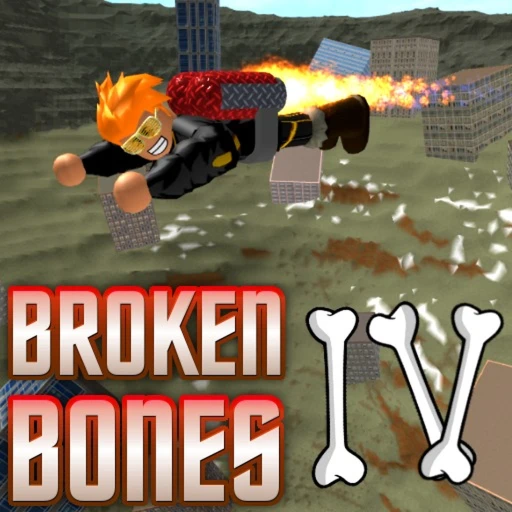
Broken Bones IV distills its gameplay into a loop that sounds absurd on paper and feels satisfying in practice. You stand at the top of a cliff, jump off, and try to break as many bones as possible before your ragdoll body comes to a stop. The more bones you break and the more damage you accumulate, the more in-game cash you earn. You spend that cash on abilities, upgrades, and access to new jump locations that offer even more destructive potential.
The genius of the design is that failure is the entire point. In most games, falling off a ledge is a punishment. In Broken Bones IV, it is the core mechanic. Every fall is an opportunity to experiment with angles, body positioning, and timing. Do you launch yourself straight down for maximum impact speed? Do you aim for a series of rocky outcrops that will bounce your ragdoll body through multiple collision points? Do you try to angle your head into the terrain for the massive damage multiplier that head impacts provide?
The ability system adds strategic depth that transforms mindless falling into a surprisingly cerebral experience. Abilities like rocket boosts, mid-air adjustments, and speed multipliers give you tools to control your descent. A skilled player does not just fall -- they engineer a fall. They choose their launch angle, activate abilities at precise moments during the descent, and manipulate their trajectory to hit terrain features that maximize bone breaks and damage numbers.
Head hits deserve special mention because they represent the highest-risk, highest-reward mechanic in the game. Landing headfirst into a hard surface multiplies your damage dramatically, but it requires precise control over your ragdoll's orientation during the fall. Mastering head-first landings is what separates casual players from damage leaderboard contenders, and the difference in scores between a clean head hit and a standard body impact can be orders of magnitude.
The progression loop ties everything together. Early cash earnings let you purchase basic abilities and unlock new areas. Better abilities lead to higher damage scores. Higher damage scores generate more cash per fall. More cash unlocks advanced abilities and premium jump locations with taller cliffs, more obstacles, and greater damage potential. The loop feeds itself in a way that keeps each session feeling productive, even if you are just throwing yourself off the same cliff repeatedly.
Tower of Hell: Precision Under Pressure
Tower of Hell inverts the entire premise. Instead of falling down and celebrating the impact, you climb up and dread it. Each round presents a randomly generated tower assembled from a pool of pre-built sections. Your goal is simple: reach the top before the timer runs out. The catch is that there are no checkpoints. If you fall from the tenth section of a twelve-section tower, you start over at the bottom. Every single time.
The gameplay demands a specific type of skill that is different from what most Roblox games ask for. You need precise spatial awareness to judge jump distances on unfamiliar geometry. You need consistent execution to chain dozens of successful jumps without a single mistake. You need composure to maintain focus as you climb higher and the consequences of falling grow more severe. And you need adaptability, because the random tower generation means you cannot rely on memorized routes.
Each tower section tests different platforming skills. Some sections feature narrow beams that demand careful walking speed management. Others involve wall jumps, spinning obstacles, disappearing platforms, or precision timing on moving elements. The sections range from manageable to genuinely brutal, and the random combination system means a tower might chain three difficult sections back to back or give you a run of easier ones followed by a section that stops you cold.
The timer adds a layer of pressure that compounds the difficulty. You cannot take your time and inch through each section carefully -- the tower will rotate to a new one if you are too slow. This forces players to find the balance between speed and caution, and that balance point shifts depending on the specific sections in the current tower. Aggressive speed works on sections with wide platforms. Careful precision is mandatory on sections with narrow beams or killbricks.
The emotional arc of a Tower of Hell run is distinct from anything Broken Bones IV offers. Early sections feel manageable. Mid-tower sections create growing tension. Upper sections produce genuine anxiety. And the final section, with the top in sight, creates an adrenaline spike that makes your inputs less precise at the exact moment you need them to be most accurate. Managing that pressure is a skill unto itself, and it is what makes reaching the top feel like a genuine accomplishment rather than a routine completion.
Skill Curve and Player Accessibility
Broken Bones IV: Everyone Can Fall
Broken Bones IV has one of the most accessible entry points of any game on Roblox. The minimum viable action -- jumping off a cliff -- requires pressing a single button. Your very first fall will break bones, generate damage numbers, and earn you cash. There is no tutorial needed, no complex controls to learn, and no failure state that prevents progress. You jumped, you fell, you earned something. The game validates your participation from the first second.
The skill ceiling, however, is dramatically higher than the skill floor. Optimizing damage requires understanding the physics engine at a granular level. Which surfaces produce the most collision damage? How does fall speed interact with impact angle? What is the optimal ability rotation for a specific cliff geometry? How do you maintain enough ragdoll momentum after an initial impact to chain into additional collisions? These questions have answers that take dozens of hours to fully understand, and the gap between a casual player's damage numbers and an optimized player's numbers can be a factor of a hundred or more.
The progression system smooths the skill curve by giving less skilled players incremental power increases. Even if your fall technique is mediocre, the abilities and upgrades you purchase with your earnings make subsequent falls more productive. This creates a satisfying sense of forward momentum regardless of your raw skill level. You are always getting better, either through improved technique or through purchased upgrades, and usually through both simultaneously.
New players never feel stuck in Broken Bones IV. There is always a new ability to save up for, a new area to unlock, or a new personal damage record to chase. The game meets you at your current skill level and gives you reasons to keep playing at every point along the progression curve.
Tower of Hell: Sink or Swim
Tower of Hell does not hold your hand. The skill floor is high relative to most Roblox games, and the no-checkpoint design means beginners will spend the majority of their early sessions falling back to the bottom and restarting. There is no gradual difficulty introduction -- the first tower you encounter might contain sections that veteran players find challenging. The game does not scale to your ability. You scale to the game, or you do not progress.
This steep entry barrier filters the player base in a specific way. Players who stick with Tower of Hell past the initial frustration period tend to be motivated by challenge and self-improvement. They find satisfaction in the incremental skill gains that come from repeated practice -- getting one section further than last time, recognizing a section type and knowing the approach before they reach it, developing the muscle memory for specific jump patterns that initially seemed impossible.
The skill ceiling in Tower of Hell is defined by consistency rather than peak performance. Almost any player can complete a single difficult section given enough attempts. The challenge is completing every section in a tower without failing any of them. This consistency requirement means that skill growth in Tower of Hell is not about learning new mechanics but about reducing your error rate to near zero across dozens of consecutive actions. It is a different kind of mastery than what Broken Bones IV asks for, and it appeals to a different type of player.
For players who find satisfaction in overcoming punishing difficulty through persistent practice, Tower of Hell is deeply rewarding. For players who want to feel accomplished from their very first session, it can be genuinely discouraging. There is no middle ground in how Tower of Hell treats its players, and that polarizing design is both its greatest strength and its most significant weakness.
Edge: Broken Bones IV for accessibility and beginner friendliness. The game welcomes players of all skill levels and provides rewards from the very first fall. Tower of Hell wins for those who specifically seek punishing difficulty, but its steep entry barrier turns away many players who might otherwise enjoy it.
Physics and Technical Design
Broken Bones IV: Physics as the Foundation
Physics is not just a feature in Broken Bones IV -- it is the entire game. The ragdoll physics engine determines everything: how your body tumbles through the air, how it interacts with terrain geometry on impact, how momentum transfers through collisions, and how individual bones break based on the force applied to specific body parts. The physics simulation is the gameplay, and every other system in the game exists to interact with it.
The quality of the ragdoll system is what makes the game work. Bodies react to impacts in ways that feel unpredictable enough to be entertaining but consistent enough to be learnable. A glancing blow off a rocky outcrop sends your ragdoll spinning in a direction that makes physical sense, even if the exact rotation is hard to predict. A head-on collision with a flat surface produces a satisfying crunch and a massive damage number. The feedback loop between input (your launch angle and ability usage), physics simulation (how your body interacts with the environment), and output (damage numbers and cash earned) is tight and responsive.
The terrain design works in service of the physics engine. Cliffs feature outcrops, ledges, ramps, and obstacles that create interesting collision opportunities. Different surfaces have different properties. Some areas funnel your ragdoll into high-damage corridors. Others spread impacts across multiple collision points for chain damage. The map design is essentially puzzle design -- the puzzle being how to extract maximum damage from each terrain layout using your available abilities and fall trajectory.
Over the years, Zaquille has refined the physics to reduce frustrating edge cases while maintaining the chaotic energy that makes the game entertaining. Early versions had issues with bodies getting stuck on geometry or phasing through terrain. The current iteration handles these situations much more gracefully, though occasional physics glitches still produce hilarious results -- which, in a comedy game, arguably counts as a feature rather than a bug.
Tower of Hell: Physics as a Constraint
Tower of Hell uses Roblox's standard character physics engine for jumping, walking, and falling. The physics in Tower of Hell are not a spectacle -- they are a set of rules you must work within. Jump height, movement speed, fall distance, and collision boundaries are consistent and predictable. This predictability is essential because the game demands precise execution, and inconsistent physics would make precision impossible.
The technical achievement in Tower of Hell is not the physics engine but the procedural generation system. The game assembles towers from a large library of hand-designed sections, connecting them in random order while maintaining playability. This generation system must ensure that every tower is completable -- that no section transition creates an impossible gap or unreachable platform. The fact that it works as consistently as it does across billions of plays is an engineering accomplishment that deserves recognition.
The platforming physics are deliberately simple. You have a jump, you have movement, and you have a wall-jump in certain contexts. There are no complex movement mechanics to learn, no momentum exploits to master, and no physics quirks to discover. The simplicity is intentional -- the challenge comes from execution and spatial awareness, not from mastering a complex movement system. Every player has the same tools, and the difference between success and failure is entirely about how well you use them.
Edge: Broken Bones IV for physics as a gameplay system. The ragdoll engine is genuinely impressive and provides the entire entertainment value of the game. Tower of Hell's physics are competent but intentionally unremarkable -- they serve the gameplay without being the gameplay.
Replayability and Content Longevity
Broken Bones IV: Progression-Driven Returns
Broken Bones IV keeps you coming back through a well-designed progression loop. The cash you earn from falls feeds into a tree of abilities and upgrades that meaningfully change how you play. Early abilities might give you a simple speed boost at launch. Later abilities let you redirect mid-air, activate ragdoll mode at specific moments, or multiply your damage through timed inputs. Each new ability changes the optimal strategy for every jump location, which means unlocking a new ability effectively refreshes content you have already played.
The multiple jump locations provide geographic variety. Different cliffs and structures offer different fall geometries, obstacle layouts, and damage opportunities. A tall, sheer cliff produces a different gameplay experience than a tiered hillside with multiple impact surfaces. New locations unlock as you progress, giving you fresh terrain to experiment with at regular intervals throughout the progression curve.
The damage leaderboard provides an endgame for players who have unlocked everything. Once you have all the abilities and access to all locations, the game shifts from a progression experience to an optimization challenge. How much damage can you squeeze out of a single fall? The answer is always "more than your current record," and chasing that number provides motivation long after the upgrade path is complete.
The limitation is that the content is ultimately finite. There are a fixed number of abilities, a fixed number of locations, and a fixed set of terrain geometries. Once you have seen everything, the novelty factor diminishes. The game relies on the damage optimization loop to maintain engagement past the content boundary, and whether that loop sustains your interest depends on how much you enjoy chasing numbers.
Tower of Hell: Procedural Infinity
Tower of Hell's replay value comes from the same source that makes it challenging: random generation. Every tower is a unique combination of sections, and the section library is large enough that repeating the exact same tower is functionally impossible. You could play Tower of Hell every day for a year and never encounter the same tower layout twice. This built-in freshness is the game's greatest retention tool and the primary reason it has accumulated over 21 billion visits.
The timed rotation system reinforces replayability by creating urgency. Each tower is available for a limited window before a new one generates. If you do not complete the current tower before the timer runs out, that specific layout is gone forever. This ephemeral quality gives every tower a sense of significance -- this particular combination of sections will never exist again, and your window to conquer it is closing. The FOMO effect is subtle but powerful.
The massive player base amplifies replay value through social competition. With thousands of concurrent players across servers, there is always someone to race against. Watching another player reach the top while you are stuck on the eighth section provides immediate, visceral motivation to try harder. The shared experience of attempting the same tower simultaneously creates organic stories and memorable moments that single-player content cannot replicate.
Tower events introduce periodic variety that breaks the standard gameplay loop. Inverted towers, fog modifiers, speed changes, and other event types create novel challenges that keep veterans engaged. These events are infrequent enough to feel special when they appear and different enough from standard towers to require adapted strategies.
Edge: Tower of Hell. Procedural generation provides functionally infinite content variety. Broken Bones IV's progression system is well-designed but ultimately bounded by its fixed content. For pure replay value measured in "how long before the game feels stale," Tower of Hell wins decisively.
Social Features and Multiplayer Experience
Broken Bones IV: Shared Chaos
Broken Bones IV's multiplayer is best described as parallel play with shared spectacle. Multiple players occupy the same server and can jump simultaneously, but each player's fall is fundamentally an individual experience. You launch from the same cliff, but your ragdoll trajectory is your own. The social element comes from comparison and spectation rather than direct interaction.
Watching other players' ragdoll physics in action is genuinely entertaining. Someone gets launched at an unexpected angle, bounces off three outcrops in sequence, and lands headfirst in a crevice for massive damage. The physics engine produces moments of unscripted comedy that are best experienced with others who can appreciate them. The shared laughter of watching a particularly absurd ragdoll sequence is a core part of the Broken Bones IV social experience.
Damage comparisons provide informal competition. Seeing another player post a damage number that dwarfs yours creates natural motivation to improve your technique. The competitive dynamic is friendly rather than adversarial -- you are not competing for the same resources or interfering with each other's gameplay. You are simply trying to fall better than the person next to you, which is a uniquely absurd form of competition that fits the game's comedy tone.
The social ceiling is relatively low compared to games designed around multiplayer interaction. There are no team mechanics, no trading systems, and no cooperative objectives. The game is a social experience in the same way that a bowling alley is social -- you are doing your own thing alongside other people, with natural moments of shared excitement and friendly competition.
Tower of Hell: Visible Competition
Tower of Hell's multiplayer design is more directly competitive. All players in a server attempt the same tower simultaneously, and you can see other players climbing above and below you in real time. This visibility transforms an individual challenge into a race. Watching someone pull ahead of you on the tower creates urgency. Passing someone who was ahead of you creates satisfaction. Seeing someone fall from the top section creates a mix of sympathy and relief.
The social dynamics during a tower attempt are rich and varied. Players develop unspoken rivalries with others at similar skill levels. You notice the same players reaching the same sections you do, and a natural competition forms without any explicit matchmaking. When one of these informal rivals reaches the top before you, it stings in a way that motivates improvement. When you reach the top first, the victory feels personal.
The shared frustration of a particularly difficult tower creates community bonding. When an entire server is struggling with the same punishing section, there is a collective experience that brings players together. Chat fills with reactions to falls, encouragements, and shared despair. These moments of communal struggle are unique to Tower of Hell's design and cannot be replicated in a game where everyone is having an independent experience.
Content creation has amplified Tower of Hell's social presence. The game's dramatic moments -- clutch completions, devastating falls, impossible section clears -- are inherently shareable. YouTube and TikTok are saturated with Tower of Hell clips that showcase both incredible skill and spectacular failure, and this content pipeline keeps the game culturally relevant across social platforms.
Edge: Tower of Hell for meaningful social interaction and competitive multiplayer. The visible race dynamic creates richer social experiences than Broken Bones IV's parallel play model. Broken Bones IV wins for casual, low-pressure social play where the entertainment comes from shared spectacle rather than direct competition.
Monetization and Value
Both games are free to play and deliver their core experiences without requiring any Robux expenditure. The monetization approaches reflect their different design philosophies.
Broken Bones IV monetizes through game passes and abilities that accelerate progression or unlock premium content. Some passes provide cosmetic changes, while others offer gameplay-affecting upgrades that increase damage potential or unlock new falling mechanics. The progression system is designed so that free players can eventually access most content through grinding, but game passes significantly reduce the time investment required. The monetization is fair in the sense that skill still matters more than purchases -- a skilled free player will out-damage an unskilled player with every pass purchased.
Tower of Hell offers game passes ranging from cosmetic effects to gameplay modifiers like double jump and speed boosts. The double jump mutator is the most impactful purchase, as it fundamentally changes how you approach tower sections by giving you an additional jump that can save a failed attempt or skip difficult sections entirely. Purists argue this undermines the challenge, while casual players appreciate the accessibility it provides. Cosmetic passes like gear effects and trail colors are purely visual and do not affect gameplay.
Neither game employs aggressive monetization tactics. There are no loot boxes, no energy systems that limit play time, and no paywalled content that fragments the player base. Both games let you play indefinitely for free and offer optional purchases that enhance the experience without being necessary to enjoy it.
Edge: Tie. Both games handle monetization responsibly. Free players get the full core experience, and purchases feel optional rather than mandatory. Neither game creates a significant gap between paying and non-paying players in terms of core enjoyment.
Player Count and Community Health
Tower of Hell holds an enormous advantage in raw player numbers. With over 21 billion total visits, it consistently ranks among the most-played games on the entire Roblox platform. Concurrent player counts regularly reach tens of thousands, and finding a populated server is never an issue. The community extends across YouTube, TikTok, Discord, and Reddit, with active discussion and content creation happening across all platforms.
Broken Bones IV's 1.4 billion visits represent a healthy and active game by any standard -- just not by Tower of Hell's extraordinary standard. The game maintains a steady player base with reliable concurrent numbers that ensure populated servers during most hours. The community is smaller but passionate, with dedicated players who have spent hundreds of hours optimizing their damage numbers and sharing strategies.
Both communities are welcoming to new players, though the nature of that welcome differs. Broken Bones IV's community tends toward casual humor and shared amusement at ragdoll physics outcomes. Tower of Hell's community has a stronger competitive undercurrent, with experienced players often offering advice to struggling newcomers alongside the inevitable ribbing when someone falls from near the top.
Edge: Tower of Hell for sheer community size and cultural presence. Broken Bones IV maintains a healthy, active community that provides a good multiplayer experience, but Tower of Hell operates on a scale that few Roblox games can match.
The Verdict
Choose Broken Bones IV if...
You want a uniquely entertaining physics playground where failure is the entire point and every fall feels like a comedy sketch written by the ragdoll engine. Broken Bones IV is the better choice for players who enjoy progression systems, experimental gameplay, and the satisfaction of watching damage numbers climb as your technique improves. Its low skill floor means anyone can have fun immediately, while its high skill ceiling rewards dedication with increasingly spectacular results. With 1.4 billion visits and a physics engine that turns gravity into entertainment, Broken Bones IV remains one of the most creative and accessible games on Roblox in 2026.
Choose Tower of Hell if...
You want the definitive Roblox skill challenge -- a game that demands precision, consistency, and composure under pressure, then rewards you with one of the most satisfying feelings of accomplishment on the platform. Tower of Hell is the better choice for players who thrive on competition, enjoy adapting to new challenges every session, and find motivation in high-stakes gameplay where every jump matters. Its procedurally generated towers ensure you never play the same layout twice, and its 21 billion visits confirm that the formula works at massive scale. If you want a game that will push your platforming skills to their absolute limit, Tower of Hell is it.
Who Should Play What?
Play Broken Bones IV if you:
- Want to have fun from your very first session with zero learning curve
- Enjoy ragdoll physics and unpredictable, comedic outcomes
- Prefer progression systems that give you new abilities and tools over time
- Find satisfaction in optimizing damage numbers and chasing personal records
- Like experimenting with different strategies and fall trajectories
- Want a relaxed, low-pressure multiplayer environment
- Appreciate games where failure is rewarded rather than punished
Play Tower of Hell if you:
- Thrive on high-stakes challenges with no safety net
- Want infinite variety through procedurally generated content
- Enjoy competitive multiplayer with visible races against other players
- Find motivation in overcoming punishing difficulty through practice
- Prefer games that test consistency and composure under pressure
- Want one of the largest active communities on Roblox
- Enjoy the adrenaline rush of reaching the top after a tense climb
For more on each game individually, check out our Broken Bones IV free Robux guide and Tower of Hell free Robux guide. And if you enjoy competitive Roblox games, our Blade Ball free Robux guide covers another title worth your time.
Earn Free Robux While You Play
Whether you choose Broken Bones IV, Tower of Hell, or both, Earnaldo helps you earn free Robux through simple tasks. No surveys, no scams -- just real Robux rewards.
Frequently Asked Questions
Tower of Hell is significantly more popular with over 21 billion total visits compared to Broken Bones IV's 1.4 billion. Tower of Hell consistently ranks among the most-played games on Roblox and maintains higher concurrent player counts. However, Broken Bones IV has a dedicated and passionate community that keeps the game active with steady player numbers.
Broken Bones IV is more beginner-friendly. You can jump off a cliff and have fun from your very first attempt with no skill required to start earning cash. Tower of Hell has a steep learning curve with no checkpoints, meaning beginners will spend most of their time falling back to the bottom and restarting. Broken Bones IV rewards failure by design, while Tower of Hell punishes it.
Yes, both games support multiplayer. Broken Bones IV lets you jump alongside friends and compare bone break counts and damage scores in the same server. Tower of Hell places all players on the same randomly generated tower, creating a visible race to the top. Both games are more entertaining with friends, though the social dynamics differ significantly between competitive climbing and collaborative chaos.
Broken Bones IV has far more advanced and central physics. The entire game revolves around its ragdoll physics engine, which simulates bone breaks, body collisions with terrain, and momentum-based damage calculations. Tower of Hell uses standard Roblox platforming physics focused on precise jumping and movement. If you care about physics simulation as a gameplay mechanic, Broken Bones IV is the clear winner.
Tower of Hell periodically releases codes for cosmetic items and effects. Check our Tower of Hell codes guide for the latest working codes. Broken Bones IV has a more limited code system with occasional promotional codes. Neither game locks essential gameplay content behind codes, so you can enjoy the full experience without them.
Both games offer strong replay value through different mechanisms. Tower of Hell generates random towers every round, so you never play the same layout twice. Broken Bones IV keeps you coming back through its progression system of unlockable abilities, new jump locations, and the constant pursuit of higher damage scores. Tower of Hell edges ahead for pure variety, while Broken Bones IV wins for progression-driven replayability.
Broken Bones IV and Tower of Hell represent two philosophies of physics-driven game design that have both proven their staying power on Roblox. One turns gravity into a comedy show where your skeleton is the punchline. The other turns gravity into the enemy that stands between you and the top of a tower. Both are worth your time in 2026, and the right choice depends on whether you would rather perfect the art of falling or master the discipline of climbing.