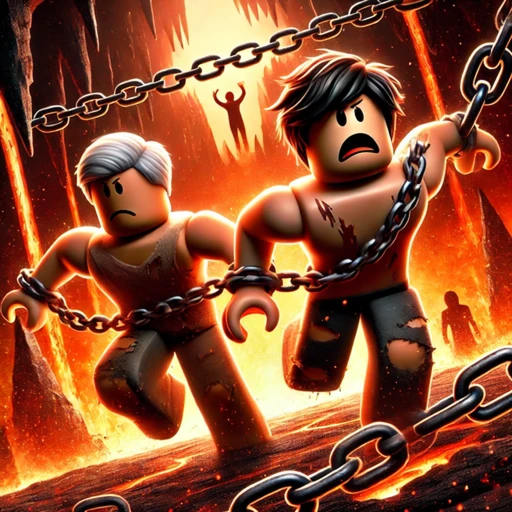
Chained Together vs Tower of Hell (2026) -- Which Roblox Obby Is Better?
Roblox obby games keep players coming back year after year, and two of the most talked-about titles in 2026 take wildly different approaches to the genre. Chained Together is a co-op obby where players are literally bound by a physics chain and must coordinate every jump to reach the top. Tower of Hell is a solo-focused gauntlet of randomly generated towers with no checkpoints and a ticking clock. Both games strip away safety nets and demand consistent execution, but the experience of playing each one could not be more different.
Chained Together, developed by Archive Experiences, has surpassed 213 million visits and carved out a reputation as one of the best cooperative platforming experiences on Roblox. Tower of Hell, built by YXCeptional Studios, is a platform giant that regularly pulls between 55,000 and 75,000 concurrent players and ranks among the most visited games in Roblox history. One thrives on teamwork, the other on individual mastery.
This guide compares every aspect that matters: gameplay mechanics, difficulty, replayability, social features, and which game fits your play style. Whether you are looking for a chaotic session with friends or a focused solo grind, you will know exactly which obby to load up by the end of this article.
Quick Stats: Chained Together vs Tower of Hell at a Glance
| Category | Chained Together | Tower of Hell |
|---|---|---|
| Developer | Archive Experiences | YXCeptional Studios |
| Roblox Place ID | 18152595062 | 5765674028 |
| Total Visits | 213M+ | 27B+ |
| Approval Rating | 74% | 85%+ |
| Genre | Co-op Obby | Solo No-Checkpoint Obby |
| Player Count | 2-5 per session | 20+ per server |
| Concurrent Players (July 2026) | Varies by time of day | 55K-75K |
| Checkpoints | None | None |
| Level Generation | Handcrafted stages | Procedural (random sections) |
| Core Mechanic | Physics chain linking players | Timed tower climbing |
| Competitive Element | Cooperative (beat the tower together) | Leaderboards + race to the top |
| Average Session | 20-40 minutes | 10-20 minutes per tower |
The numbers paint a clear picture of two very different games. Tower of Hell dominates in raw scale and concurrent players, while Chained Together offers something Tower of Hell fundamentally cannot: a shared physical connection between players that makes every jump a team decision. Let us break down what each game does well and where each one falls short.
Core Gameplay: Cooperation vs. Individual Skill
Chained Together: Your Team Is Your Greatest Asset and Your Biggest Liability
Chained Together builds its entire identity around a single mechanic: a physics-simulated chain that connects every player in your group. You and up to four other players spawn at the bottom of a vertical obby course, tethered together by chains that respond to real physics. When one player jumps, the chain pulls. When one player falls, the chain drags. Every action you take affects the people attached to you, and every action they take affects you.
This creates a gameplay dynamic that no solo obby can replicate. Platforming in Chained Together is not about executing jumps in isolation -- it is about timing your jumps in concert with your teammates, managing chain tension so nobody gets yanked off a ledge, and communicating constantly about when to move and when to wait. A perfectly timed jump means nothing if your partner jumps a half-second later and the chain physics snap you both off the platform.
The game supports groups of two to five players, and the difficulty scales dramatically with group size. Two players connected by a single chain is manageable once you develop a rhythm. Five players connected by chains is controlled chaos where a single mistake from anyone can cascade into a full wipe. The chain does not just connect you physically -- it connects your fates. Your success depends on the weakest platformer in the group, which creates a fascinating social pressure that Tower of Hell never touches.
Archive Experiences designed the stages to exploit the chain mechanic in creative ways. Some platforms are spaced so that the chain barely reaches, forcing your group to stretch out in a precise formation. Other sections require players to swing each other across gaps using the chain's pendulum physics. There are moments where one player needs to anchor themselves while others use the chain tension to reach otherwise impossible platforms. The level design treats the chain as a tool, not just a handicap.
Tower of Hell: Pure Platforming Distilled
Tower of Hell strips obby gameplay down to its essence: you, the tower, and a timer. There are no teammates to coordinate with, no chain physics to manage, and no external variables beyond your own execution. Every tower is a vertical stack of randomly selected sections pulled from a massive pool, and your job is to climb from bottom to top before the timer expires and a new tower generates.
The beauty of Tower of Hell's design is its simplicity. You learn section patterns through repetition, develop muscle memory for common obstacles, and gradually build the consistency needed to chain multiple sections together without falling. The game rewards individual skill development in the purest possible way -- there is nothing between you and the top except your own ability to platform.
Each server holds around twenty players, all climbing the same tower simultaneously. You can see other players ahead of you and behind you, creating a visible competitive dynamic without any direct interaction. Watching someone else nail a section you keep failing on is motivating. Watching someone fall from the top when you are halfway up is both terrifying and relieving. The shared server experience adds social texture to what is fundamentally a solo challenge.
The no-checkpoint design is the defining feature. Fall from the ninth section of a twelve-section tower, and you go back to the ground floor. There are no saves, no midway respawns, and no mercy. This single design choice creates the tension that keeps players coming back. Every jump carries weight because the consequences of failure are always total.
Edge: Chained Together for gameplay innovation and social mechanics. The physics-chain system creates a cooperative experience that stands alone on Roblox. Tower of Hell wins for pure platforming purity -- if you want to test your skills without relying on anyone else, nothing on the platform does it better.
Difficulty and Frustration Management
Chained Together: Difficulty You Cannot Control
The hardest part of Chained Together is not the platforming itself -- it is the people you are chained to. The individual jumps and obstacles in Chained Together are generally less mechanically demanding than Tower of Hell's toughest sections. The difficulty comes from executing those jumps while physically connected to other players whose timing, skill level, and decision-making you cannot control.
Playing with experienced friends who communicate well transforms Chained Together into a satisfying coordination challenge where your group moves as a unit, calling out jumps and managing chain positions with precision. Playing with random players through matchmaking can be an exercise in patience as one person consistently mistimes jumps and pulls the group off platforms. The game does not have a way to disconnect from a struggling teammate -- you are committed to your chain, for better or worse.
The no-checkpoint system amplifies every mistake exponentially. In Tower of Hell, your mistake only costs you. In Chained Together, one person's mistake costs everyone. Falling from near the top because a teammate missed a jump they had already landed three times is a specific kind of frustration that Tower of Hell simply does not produce. The emotional stakes are higher because the shared responsibility means blame and frustration have a target.
On the flip side, the shared struggle creates bonding moments that solo games cannot match. Helping a struggling teammate through a difficult section, catching someone with chain tension before they fall, or finally clearing a stage after dozens of attempts together produces genuine euphoria. The highs are higher because the lows are so punishing.
Tower of Hell: Difficulty You Own Completely
Tower of Hell's difficulty is entirely self-contained. Every failure is your failure. Every success is your success. There is nobody to blame when you fall and nobody to thank when you reach the top. This individual accountability creates a cleaner feedback loop for skill development -- you can identify exactly what went wrong, practice the specific section that tripped you up, and improve methodically.
The random tower generation means difficulty varies significantly from tower to tower. Some tower configurations are relatively straightforward, stacking easier sections that most experienced players can clear in a single attempt. Others combine notoriously difficult sections back to back, creating gauntlets that even veteran players struggle with. You cannot choose your tower, so adaptability is as important as raw skill.
Certain sections have become legendary within the community for their difficulty. Names like "The Great Wall," "Prison Escape," and other infamously punishing sections make experienced players groan when they appear in a tower. Learning to handle these sections consistently separates casual players from dedicated climbers. The random element means you cannot avoid them -- sooner or later, you will face the sections you dread most.
The timer adds a secondary difficulty layer that Chained Together lacks. Even if you can clear every section with enough time and patience, the tower rotation means you have a fixed window to complete the climb. This time pressure forces faster, riskier play that increases the chance of mistakes. The tension between speed and safety is a constant negotiation that gives every tower attempt a sense of urgency.
Edge: Tower of Hell for fair, skill-based difficulty where improvement is measurable and progress feels earned. Chained Together wins for emotional intensity -- the shared stakes of cooperative play create higher highs and lower lows than any solo experience can deliver.
Replayability and Content Longevity
Chained Together: Replay Value Through People, Not Procedural Generation
Chained Together's stages are handcrafted rather than randomly generated, which means the level layouts stay the same across playthroughs. On paper, this should limit replay value compared to Tower of Hell's infinite procedural towers. In practice, the replay value comes from the human element. The same stage plays completely differently depending on who you are chained to.
A stage that your experienced friend group cleared on the first attempt might take an hour with a group of randoms. The chain physics introduce enough variability that even memorized stages produce unexpected moments -- a slightly mistimed jump, an unexpected chain pull, a creative solution to a section that your group discovers organically. The level content is static, but the experience of playing through it is dynamic because the human variables change every session.
The game also benefits from the "one more try" factor that cooperative challenges produce. When your group fails at the final section, the collective determination to run it back is powerful. The shared investment in a successful run creates social momentum that keeps sessions going longer than the content alone might warrant. Chained Together sessions often run 30 to 60 minutes because the group refuses to quit until they clear the stage together.
The limitation is real, though. Once your regular group has mastered all the stages, the cooperative challenge diminishes. The game needs fresh content additions to maintain long-term engagement for dedicated groups, and update cadence from Archive Experiences has been moderate rather than aggressive.
Tower of Hell: The Machine That Never Runs Out
Tower of Hell's procedural generation is the gold standard for obby replayability on Roblox. The system pulls from a pool of hundreds of pre-built sections and assembles them into unique tower configurations that rotate on a timer. You will never climb the same exact tower twice. This simple but effective system has sustained the game for years and kept concurrent player counts in the tens of thousands through 2026.
The tower rotation timer is a critical replayability driver. Each tower exists for a limited window before being replaced by a new generation. If you do not finish the current tower in time, that specific combination of sections disappears permanently. This creates a "now or never" urgency that keeps players attempting tower after tower instead of walking away after a single failure. You always want to see what the next tower looks like. You always want one more attempt.
The section pool continues to grow as the developers add new community-created and studio-designed sections. This means the variety increases over time rather than stagnating. Veteran players who have seen hundreds of sections still encounter unfamiliar ones, which prevents the pattern recognition that can make static content feel stale.
Special events and tower modifiers add periodic variety on top of the base randomization. Inverted towers, fog effects, low-gravity modifiers, and other special conditions transform familiar sections into new challenges. These events appear infrequently enough to feel special while happening often enough to prevent monotony during extended play sessions.
Edge: Tower of Hell by a significant margin. Procedural generation provides functionally infinite content that keeps the game fresh across thousands of play sessions. Chained Together's replay value is real but depends on social variables rather than content variety, which means it diminishes faster for groups that play together regularly.
Social Features and Community
Chained Together: Built for Connection
Social interaction is not a feature of Chained Together -- it is the entire game. You cannot play without other people, and the chain mechanic forces constant communication, negotiation, and cooperation. The game creates social situations that purely competitive or solo games never produce: the patience of waiting for a struggling teammate, the trust of swinging someone across a gap, the shared celebration of finally reaching the top.
The 2-5 player structure makes it an excellent game for small friend groups. It is one of the best Roblox experiences for players who want to actually play together rather than merely play in proximity to each other. Most Roblox multiplayer games put players in the same server but do not create genuine interdependence. Chained Together makes your success literally dependent on your teammates, which produces social bonds that casual multiplayer cannot.
The community around Chained Together skews toward groups of friends who play together regularly. Content creators have found success filming the game because the cooperative failures and triumphs make for entertaining viewing. Watching a five-person chain collapse because one person sneezed at the wrong moment is exactly the kind of content that performs well on YouTube and TikTok. The game generates shareable moments organically.
The flip side is that playing with random players can be inconsistent. Without voice communication and shared experience, random groups often struggle to develop the coordination needed to clear stages. The game is at its best with friends and at its most frustrating with strangers, which limits its appeal for solo players looking for a drop-in experience.
Tower of Hell: Community at Scale
Tower of Hell's community operates at a fundamentally different scale. With 55,000 to 75,000 concurrent players in May 2026, the game supports one of the largest active communities on Roblox. Finding a populated server is never an issue. The cosmetic shop gives players a way to express themselves visually, and the leaderboard system creates competitive hierarchies within each server that motivate improvement.
The social experience in Tower of Hell is competitive rather than cooperative. You share a tower with other players, but you are racing against them rather than working with them. The visible competition -- seeing other players ahead of you, watching someone fall from near the top, overtaking a rival on a difficult section -- creates a social dynamic that does not require communication to function. It is social through shared experience rather than through direct interaction.
The content creation community around Tower of Hell is massive. Speedrun compilations, "first to the top" challenges, difficulty tier lists, and challenge videos accumulate millions of views across platforms. The game's inherent drama makes it a natural fit for content creation, and the procedural generation means creators never run out of fresh material to film. The community sustains itself through content creation in a way that smaller games cannot replicate.
Tower of Hell also has a strong competitive leaderboard culture. Players track their completion counts, fastest times, and consistency rates. While the random generation prevents direct tower-to-tower time comparisons, the overall statistics create meaningful long-term goals that keep dedicated players engaged across hundreds of sessions.
Edge: Chained Together for depth of social connection and genuine cooperative play. Tower of Hell wins for community scale, content creation potential, and accessibility for solo players who want a social atmosphere without requiring friends to play.
Monetization and Value
Both games are free to play, and neither gates core gameplay behind purchases. Chained Together offers a straightforward experience where the full game is accessible to all players without spending Robux. The focus is on the cooperative experience rather than cosmetic progression or gameplay-modifying passes.
Tower of Hell provides a broader monetization ecosystem with game passes for cosmetic effects, mutators like double jump, and visual customizations. The double jump mutator provides a tangible gameplay advantage that makes towers more forgiving, though it is not required for completion. The cosmetic shop gives players long-term goals to work toward with in-game currency earned through successful climbs. Serious competitive players typically avoid mutator passes to maintain the purity of their achievements.
Neither game pressures you to spend money. Tower of Hell's cosmetic shop is visible but not intrusive, and Chained Together does not have pay-to-win mechanics of any kind. Both games deliver their core experiences without requiring any financial investment.
Edge: Tie. Both games offer fair free-to-play experiences. Tower of Hell has more optional content to purchase, but none of it is necessary. Chained Together keeps things clean and simple with no monetization pressure.
Performance and Technical Polish
Chained Together: Physics Complexity Adds Overhead
The physics-based chain system that defines Chained Together's gameplay also creates its biggest technical challenge. Simulating real-time chain physics for multiple connected players requires more processing power than standard obby gameplay. On lower-end devices, the chain behavior can feel less responsive, and latency between players can cause chain positions to desync temporarily. Archive Experiences has improved performance through updates since launch, but the inherent complexity of networked physics means some jankiness is unavoidable.
The game handles group sizes well from a technical standpoint. Two-player chains are smooth and responsive on most devices. Five-player chains introduce more physics calculations and can produce occasional visual glitches where the chain appears to stretch or clip through geometry. These issues are cosmetic rather than game-breaking, but they can be disorienting during precise platforming sections.
Tower of Hell: Lightweight and Optimized
Tower of Hell runs well on virtually any device that can handle Roblox. The clean, functional visual design means there is minimal rendering overhead, and the procedural generation system loads sections efficiently. Server performance remains stable even with twenty or more players climbing simultaneously. The game has been optimized over years of active development, and it shows -- frame drops and lag spikes are rare even on mobile devices.
The simplicity of the game's technical requirements is a significant accessibility advantage. Players on older phones, budget tablets, and low-spec computers can run Tower of Hell without issues. This broad device compatibility contributes directly to the game's massive player counts -- there is no hardware barrier preventing anyone from playing.
Edge: Tower of Hell for technical performance and device compatibility. The lightweight design runs well everywhere. Chained Together's physics system is impressive but introduces technical overhead that can impact the experience on lower-end hardware.
The Verdict
Choose Chained Together if...
You want a cooperative obby experience that demands real teamwork, communication, and shared investment with friends. Chained Together is the better choice for players who have a regular group to play with and want a game that creates genuine social bonds through shared struggle. The physics-chain mechanic produces moments of hilarity, frustration, and triumph that solo games cannot touch. With 213 million visits and a 74% approval rating, it has earned its place as one of the best co-op obbies on Roblox. If your priority is playing with friends rather than playing near friends, this is the game.
Choose Tower of Hell if...
You want a pure platforming challenge that tests individual skill with infinite variety and no excuses. Tower of Hell is the better choice for players who prefer solo progression, competitive leaderboards, and a game that always has fresh content waiting. The procedural generation means you will never run out of new towers to climb, and the massive community ensures populated servers at any hour. With 55,000 to 75,000 concurrent players in May 2026 and billions of total visits, Tower of Hell is the proven obby king on Roblox for good reason.
Who Should Play What?
Play Chained Together if you:
- Have a group of 2-5 friends who play Roblox together regularly
- Want genuine cooperative gameplay, not just shared servers
- Enjoy physics-based mechanics that create unexpected moments
- Prefer teamwork challenges over individual skill tests
- Like games that produce shareable, memorable stories
- Want an obby that rewards communication and coordination
- Are looking for something different from every other obby on Roblox
Play Tower of Hell if you:
- Prefer solo challenges where your skill determines your success
- Want infinite replayability through procedural generation
- Enjoy competitive leaderboards and racing other players
- Play on a lower-end device that needs a lightweight game
- Want a massive community with populated servers at all hours
- Like the pressure of timed runs with no checkpoints
- Prefer drop-in gameplay that does not require coordinating with friends
For detailed guides on earning free Robux while playing each game, check out our Chained Together free Robux guide and Tower of Hell free Robux guide.
Earn Free Robux While You Play
Whether you pick Chained Together, Tower of Hell, or both, Earnaldo helps you earn free Robux through straightforward tasks. Real rewards, no gimmicks.
Frequently Asked Questions
It depends on context. Chained Together's difficulty comes from coordinating with other players while dealing with physics-based chain mechanics. A weak link in your group can drag everyone down. Tower of Hell is harder as a pure solo platforming test because there are no checkpoints and the towers are randomly generated. If you are playing Chained Together with skilled friends, Tower of Hell is the tougher experience. If your teammates are beginners, Chained Together can feel far more punishing.
Chained Together is designed for 2-5 players and requires at least one partner to play as intended. The chain mechanic is the core of the game, and playing solo removes the central challenge. Tower of Hell is the better choice if you want a solo obby experience, since it is built around individual skill and does not require other players to function.
Tower of Hell has a larger concurrent player base, regularly pulling 55,000 to 75,000 concurrent players in May 2026. Chained Together has accumulated over 213 million visits but runs at lower concurrent numbers because it requires coordinated groups rather than drop-in solo play. Both games have healthy, active communities.
Chained Together is the superior friend experience by a wide margin. The entire game is built around cooperation, communication, and shared struggle. Being literally chained to your friends creates hilarious moments and genuine teamwork. Tower of Hell supports multiplayer in the sense that you share a server, but you are climbing independently. If co-op gameplay is your priority, Chained Together is the clear pick.
Neither game has traditional checkpoints. Chained Together requires your group to platform from the bottom to the top without checkpoint saves, and falling pulls your entire chain down. Tower of Hell similarly has no checkpoints -- one mistake sends you back to the base of the tower. Both games use this no-checkpoint design to create high-stakes tension, though the emotional impact hits differently when your fall also affects your teammates in Chained Together.
Neither game is particularly beginner-friendly due to the lack of checkpoints, but Tower of Hell is the easier entry point for new players. You only need to worry about your own execution, and you can learn section patterns through repetition. Chained Together adds the complexity of coordinating with other players, and a single inexperienced teammate can hold back the entire group. New players should start with Tower of Hell to build platforming fundamentals before tackling Chained Together.
Chained Together and Tower of Hell represent two fundamentally different visions of what an obby can be. One asks whether you and your friends can move as one. The other asks whether you alone have the consistency to reach the top. Both are worth playing in 2026, and the right choice comes down to whether you want to share the chain or climb on your own terms.