Mini War vs RIVALS (2026) -- Which Roblox Game Is Better?
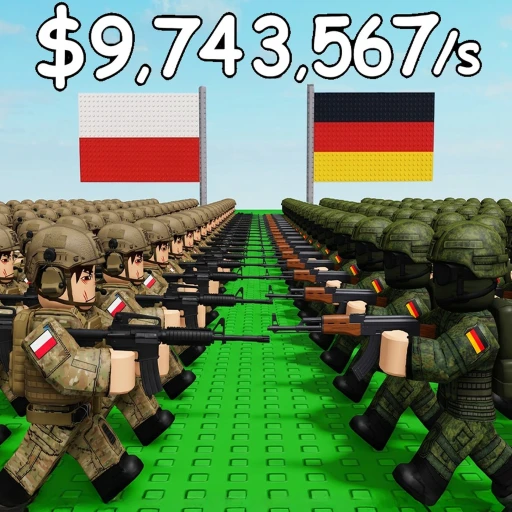
Mini War and RIVALS both feature combat on Roblox, but they approach it from entirely different angles. One is a slow-burn strategy game where you build a nation from the ground up, grow an economy, and train armies to crush your opponents. The other is a lightning-fast FPS where every round comes down to crosshair placement and split-second reflexes. Mini War pulls around 17,000 concurrent players and has accumulated 9.6 million visits since its March 2026 launch. RIVALS dominates the platform with roughly 183,000 concurrent players and billions of total visits, making it the top FPS on Roblox by a wide margin.
This comparison digs into every angle that matters: gameplay loops, progression depth, visuals and audio, community size, monetization fairness, social features, and long-term replay value. By the end, you will know exactly which game fits the way you play.
Quick Stats: Mini War vs RIVALS at a Glance
| Category | Mini War | RIVALS |
|---|---|---|
| Genre | Strategy / War | Competitive FPS |
| Place ID | 131346454575416 | 17625359962 |
| Developer | M&M Community | Nosniy Games |
| Concurrent Players | ~17,000 | ~183,000 |
| Total Visits | 9.6 million | Billions |
| Core Loop | Build country, grow economy, train army, wage war | Queue match, aim, shoot, win rounds |
| Key Features | Nation building, resource management, diplomacy, army training | VALORANT/CS2-style gunplay, ranked ladder, weapon classes, maps |
| Trading | Yes (resource and alliance trading) | No |
| Mobile Friendly | Yes | Yes (mobile-first design) |
| Free to Play | Yes | Yes |
The raw numbers make the scale difference clear, but player count alone does not determine which game is right for you. Mini War is a fresh strategy title that launched just two months ago and is growing fast. RIVALS has had years to build its audience into a Roblox juggernaut. What matters more is how each game actually feels when you sit down and play.
Gameplay: Strategy Planning vs Twitch Reflexes
Mini War Gameplay
Mini War drops you into a world where you control a fledgling nation. Your first task is establishing your country — placing buildings, allocating workers, and setting up the basic economic infrastructure that fuels everything else. Resources flow in over time: currency from taxes, raw materials from mines and farms, and military supplies from factories. Every decision you make about how to allocate those resources shapes how your nation develops.
The economic layer runs deeper than most Roblox strategy games. You are not just clicking a button to upgrade a building and waiting. You are making real trade-offs. Investing heavily in military infrastructure early means your economy grows slower, but you can defend against aggressive neighbors. Focusing on economic growth leaves you vulnerable in the short term but sets you up for a stronger mid-game army with better equipment and higher troop counts.
Combat in Mini War is army-based. You train infantry, vehicles, and specialized units, then deploy them against other players or AI-controlled territories. Battles play out based on army composition, unit levels, terrain advantages, and numerical superiority. The player who planned better over the preceding 30 minutes of economic buildup usually wins the fight — not the player who clicked faster.
Diplomacy adds another layer. You can form alliances with neighboring nations, set up trade agreements for mutual resource benefit, or betray an ally at the perfect moment to seize their territory while their army is deployed elsewhere. The social manipulation aspect gives Mini War a depth that pure combat games lack.
RIVALS Gameplay
RIVALS is a first-person shooter inspired by VALORANT and CS2, rebuilt from the ground up for the Roblox platform with a mobile-first design philosophy. You pick a weapon loadout, queue into a match, and face off against opponents in structured competitive rounds. Every round starts with a countdown, and from that moment, positioning and aim determine everything.
The weapon pool covers the standard FPS arsenal — assault rifles, SMGs, shotguns, sniper rifles, and pistols — each with distinct recoil patterns, fire rates, and effective ranges. Unlike many Roblox shooters that feel floaty or imprecise, RIVALS has tight, responsive gunplay where headshots deal significantly more damage and spray control separates good players from great ones. Learning to manage recoil on the AK-style rifle or timing peek shots with the bolt-action sniper takes genuine practice.
Maps vary in layout and size, pushing different weapon choices and playstyles. Tight corridor maps reward shotgun and SMG aggression. Open maps with long sightlines favor patient snipers and disciplined AR players. Between rounds, you can adapt your loadout based on how your opponent is playing, adding a meta-strategy layer on top of the raw mechanical skill.
Ranked matchmaking places you against opponents of similar skill and tracks your progression through tiers from Bronze to Champion. Every match has stakes, and climbing the ladder provides a long-term motivation loop that keeps players grinding for hundreds of hours.
Edge: Depends on Your Preference
This is not a case where one game outclasses the other — they test completely different skills. Mini War rewards patience, planning, and strategic thinking over sessions that last 30 minutes or more. RIVALS rewards mechanical precision, reaction time, and adaptability in bursts of 5 to 15 minutes. If you enjoy games like Civilization or Risk, Mini War speaks your language. If you gravitate toward Counter-Strike or VALORANT, RIVALS is built for you.
Progression: Building an Empire vs Climbing a Ladder
Mini War Progression
Progression in Mini War is measured by the strength and complexity of your nation. You start with a small territory and basic buildings. Over time, you unlock advanced structures like research labs, specialized military academies, and diplomatic embassies. Each building tier opens new strategic options — research labs let you develop technology upgrades that improve your economy or military, academies train elite units unavailable to newer players, and embassies expand your diplomatic reach.
Your nation's power level serves as your primary progression metric. It factors in economic output, military strength, territory size, and technology level. Climbing the global leaderboard means optimizing across all four dimensions, not just one. A player with the biggest army but a weak economy will stall out when they cannot afford to replace losses after a war. A player with a booming economy but no military gets conquered by anyone willing to attack.
Because Mini War launched in March 2026, the progression meta is still evolving. Early adopters are discovering optimal build orders, and the community is actively debating whether economy-first or military-rush strategies dominate in the current balance patch. That fresh-discovery feeling is something older games cannot replicate.
RIVALS Progression
RIVALS uses a ranked ladder system with six tiers: Bronze, Silver, Gold, Platinum, Diamond, and Champion. You gain rank points for wins and lose them for losses, with the amount scaled to the skill difference between you and your opponent. Beating a higher-ranked player yields more points than beating someone below you, and the system adjusts quickly to place you at your true skill level.
Beyond ranked, RIVALS tracks lifetime statistics — total kills, win rate, average accuracy, headshot percentage, and longest win streak. These numbers are visible on your profile and function as a reputation system. A player sitting at 60% win rate with 38% headshot accuracy has proven their skill regardless of current rank.
Cosmetic progression runs through seasonal battle passes and achievement milestones. Weapon skins, character outfits, and kill effects are earned through play or purchased with Robux. None of these items provide gameplay advantages — a founding principle the development team at Nosniy Games has maintained since launch.
Edge: Mini War for Builders, RIVALS for Competitors
Mini War progress is cumulative and tangible. Your nation grows over time, and that growth never resets. Even when you lose a war, the experience and infrastructure knowledge you gained carries forward. RIVALS progress is skill-based and dynamic. Your rank can rise or fall, and maintaining a high position demands consistent performance. Mini War rewards showing up. RIVALS rewards getting better.
Graphics and Audio
Mini War Visuals
Mini War uses a top-down strategic view with clean, readable maps and distinct building models. The art style prioritizes clarity over flashiness — you can always tell at a glance which buildings are which, where your armies are positioned, and what your opponents are doing. Military units have visible tier differences so you can assess enemy army composition before committing to a fight. For a strategy game on Roblox, the visual design is functional and well-organized.
Audio in Mini War leans toward ambient background music with military percussion that ramps up during combat. Sound cues signal important events like incoming attacks, completed research, and resource milestones, keeping you informed without demanding constant screen attention.
RIVALS Visuals
RIVALS pushes Roblox's visual capabilities further than most experiences on the platform. Maps feature detailed environments with atmospheric lighting, particle effects for gunfire and impacts, and smooth character animations. The mobile-first design means the game runs well across devices while still looking sharp on high-end hardware. Weapon models are detailed with distinct visual profiles that let you identify what an opponent is carrying from a distance.
Audio design in RIVALS is critical to gameplay. Footstep sounds reveal enemy positions. Distinct weapon firing sounds let you identify what gun your opponent is using before you see them. The spatial audio system helps you pinpoint direction, which matters enormously when holding angles or rotating between positions. RIVALS treats sound as a gameplay mechanic, not just ambiance.
Edge: RIVALS
RIVALS has a clear advantage in production polish for both graphics and audio. That said, Mini War's visuals serve their strategic purpose effectively. A strategy game does not need particle effects — it needs readable information. Both games deliver appropriate visual design for their genre.
Player Count and Community
The numbers are straightforward: RIVALS averages around 183,000 concurrent players and has accumulated billions of visits, making it one of the most popular games on all of Roblox and the undisputed top FPS on the platform. Mini War sits at roughly 17,000 concurrent players with 9.6 million visits — respectable numbers for a game that only launched in March 2026.
Mini War's community is in its early growth phase. The player base is highly engaged, with active Discord servers where members share strategies, discuss balance, and coordinate alliances. Early communities like this tend to be tight-knit and welcoming to newcomers because everyone is still learning the game together. If you join Mini War now, you are getting in during the period where the meta is being discovered rather than dictated by veteran players.
RIVALS has a massive, established community with years of accumulated knowledge. Tier lists, aim training guides, map callout sheets, and VOD reviews are readily available from content creators and community members. The RIVALS Discord is one of the most active Roblox game communities, with channels for finding practice partners, reviewing gameplay clips, and debating weapon balance changes after patches. Tournament play has developed organically, with community-organized competitions drawing hundreds of participants.
Edge: RIVALS for Scale, Mini War for Freshness
RIVALS wins on raw community size and content availability. Mini War wins on the excitement of being part of a growing game where your contributions to strategy discussion actually shape the community's collective knowledge. Both have value depending on whether you prefer joining a well-established scene or building one from the ground up.
Game Passes and Monetization
Both Mini War and RIVALS are free to play with optional purchases. Neither game locks core gameplay behind a paywall, and both can be enjoyed indefinitely without spending a single Robux.
Mini War Monetization
Mini War offers game passes focused on convenience and acceleration. Common offerings include resource boosters that increase your economic output, build-speed passes that reduce construction times, and cosmetic upgrades for your nation's visual appearance. The key question with any strategy game monetization is whether paying players gain an unfair competitive advantage. In Mini War's current state, paid boosters help you develop faster, but skilled free players can outmaneuver boosted opponents through better strategic decisions and alliance management.
RIVALS Monetization
RIVALS keeps its monetization almost entirely cosmetic. The seasonal battle pass offers exclusive weapon skins and character outfits on a premium track. Individual skin bundles range from 149 to 249 Robux. Victory emotes and kill effects round out the cosmetic catalog. The Practice Range Pro pass at 149 Robux is the one purchase with functional value, providing advanced training bots with adjustable difficulty settings that genuinely help improve your aim. No weapon stat boosts, no pay-to-win advantages, no purchased power of any kind.
Edge: RIVALS
RIVALS has a cleaner monetization model because cosmetic-only purchases eliminate any pay-to-win concerns entirely. Mini War's booster passes are common in the strategy genre and not inherently unfair, but they do blur the line between convenience and competitive advantage in ways that RIVALS avoids completely.
Social Features
Mini War Social Dynamics
Mini War is inherently social in ways that most Roblox games are not. The diplomacy system means you are constantly negotiating — forming alliances, proposing trade deals, coordinating joint military operations, and occasionally betraying partners when the strategic calculus demands it. These interactions create memorable stories. The alliance that held together for an entire server session, the betrayal that flipped the power balance, the trade deal that funded your army just in time to repel an invasion — these moments only happen because other humans are making decisions alongside you.
Resource trading connects players economically. If your nation produces surplus metal but needs food, finding a trade partner with the opposite surplus creates mutual benefit and a reason to keep the peace. The economic interdependence makes diplomacy feel grounded rather than arbitrary.
RIVALS Social Dynamics
RIVALS is social through competition. You remember the player who clutched a round at 4-4 with a flick headshot. You remember the opponent who read your position three rounds in a row and forced you to completely change your approach. The community bonds over shared competitive experiences, highlight clips, and weapon-balance debates.
Finding practice partners through the RIVALS Discord is common, and many players form small groups that queue together, review each other's gameplay, and push each other to improve. The social element is less embedded in the game mechanics than Mini War's diplomacy system, but the friendships forged through competitive grind are just as real.
Edge: Mini War
Mini War wins on social depth because diplomacy, trading, and alliance management are built directly into the core game loop. RIVALS social interaction happens mostly outside the actual matches — in lobbies, Discord, and community forums. Both approaches work, but Mini War makes human interaction a gameplay mechanic rather than a surrounding feature.
Replay Value
Mini War Longevity
Every Mini War session plays differently because the other players on your server create unique strategic situations. The nation next to you might be friendly and open to trade this time, or they might be an aggressive warmonger who attacks the moment they have enough troops. Your response changes based on their behavior, which changes based on the players around them, creating emergent scenarios that no two sessions replicate.
The game is also still in its early months. New features, balance patches, and content updates are arriving regularly. Players who invest time now are shaping the meta rather than following it. That early-adopter advantage fades quickly in most games, making the current window particularly valuable for players who enjoy being on the cutting edge of strategy development.
RIVALS Longevity
RIVALS has proven its longevity through years of sustained player engagement and billions of visits. The skill ceiling is effectively infinite — there is always a faster peek, a tighter spray pattern, or a smarter rotation to learn. Seasonal content updates refresh the cosmetic pool and occasionally introduce new maps or weapon balance changes that shift the meta. The ranked ladder provides a perpetual carrot, since reaching the next tier always feels achievable.
The FPS genre also benefits from the fact that improvement is self-reinforcing. The better you get at RIVALS, the more satisfying the game feels, because you start winning fights you previously lost. That feedback loop keeps players engaged for thousands of hours across the competitive FPS space, and RIVALS captures it effectively within the Roblox platform.
Edge: RIVALS
RIVALS has a longer proven track record and a skill ceiling that ensures the game stays challenging indefinitely. Mini War's replay value is strong thanks to emergent multiplayer dynamics, but the game needs more time to prove whether its systems have the depth to sustain engagement over months and years.
How to Earn Free Robux for Mini War and RIVALS
Both games offer optional purchases that enhance the experience — booster passes in Mini War and cosmetic battle passes in RIVALS. If you want to grab these without spending real money, Earnaldo provides a straightforward way to earn free Robux by completing simple tasks outside of Roblox. A few completed offers can cover the cost of a battle pass or game pass in either title.
You can also check out our dedicated guides for maximizing your Roblox experience: the Mini War free Robux guide, the RIVALS free Robux guide, and the Blox Fruits free Robux guide for players who enjoy multiple games.
Want Free Robux for Mini War or RIVALS?
Earn Robux by completing simple tasks on Earnaldo — then spend them on any game pass you want.
The Verdict: Mini War vs RIVALS
Mini War and RIVALS are both strong Roblox experiences that cater to fundamentally different types of players. One tests your brain over long sessions of economic planning and diplomatic maneuvering. The other tests your hands in short bursts of mechanical precision and competitive pressure. Choosing between them comes down to what you find satisfying.
Choose Mini War If...
You enjoy strategy games where planning and decision-making matter more than reflexes. You want to build something that grows over time — a nation with a real economy, a trained army, and diplomatic relationships with other players. You prefer sessions where you can think, plan, and execute at your own pace without twitch-reaction pressure. You like being part of a newer community where the meta is still being discovered and your strategic insights can genuinely influence how others play. Mini War is the pick for builders, planners, and players who find satisfaction in outsmarting opponents rather than outaiming them.
Choose RIVALS If...
You want a competitive FPS with tight gunplay, ranked matchmaking, and the satisfaction of watching your mechanical skill improve over time. You prefer short matches that fit into any schedule — 5 to 15 minutes per round with instant re-queuing. You want to join one of the largest and most active communities on Roblox with established content creators, tournament scenes, and a wealth of guides and resources. You appreciate clean cosmetic-only monetization with zero pay-to-win elements. RIVALS is the pick for competitive players, FPS enthusiasts, and anyone who thrives on adrenaline and skill-based ranking.
Who Should Play What?
- Fans of Civilization, Risk, or nation-building games: Mini War is your best match on Roblox right now.
- Fans of VALORANT, CS2, or competitive shooters: RIVALS translates that experience to Roblox better than anything else on the platform.
- Players who want long, strategic sessions: Mini War rewards the 30 to 90 minute investment with visible nation growth and meaningful economic decisions.
- Players who want quick competitive matches: RIVALS lets you get a ranked game in under 15 minutes and still feel the stakes of every round.
- Social players who love diplomacy and trading: Mini War's alliance and trade systems put human interaction at the center of gameplay.
- Players who want the biggest community and most content: RIVALS has years of accumulated guides, tournaments, and an enormous active player base.
- Mobile-first players: Both games work well on mobile, but RIVALS was explicitly designed with mobile controls in mind from day one.
Both games are free to try. If you genuinely cannot decide, start with whichever genre you have less experience with. Strategy players might discover a competitive side they did not know they had through RIVALS. FPS players might find that the slower pace of Mini War scratches an itch they did not know existed. Play Mini War here: Mini War on Roblox. Play RIVALS here: RIVALS on Roblox.
Frequently Asked Questions
RIVALS is significantly more popular, averaging around 183,000 concurrent players with billions of total visits. It stands as the top FPS on the entire Roblox platform. Mini War is a newer title that launched in March 2026 and has built up to roughly 17,000 concurrent players with 9.6 million visits. Both are growing, but RIVALS has a massive head start in audience size and brand recognition.
Yes, both games are completely free to play on Roblox. Mini War offers optional game passes for resource boosters and build-speed upgrades. RIVALS sells cosmetic items and a seasonal battle pass. All core gameplay in both titles is accessible without spending any Robux.
Mini War is generally more accessible for younger players because of its slower pace and focus on strategic planning rather than fast reflexes. RIVALS demands precise aim and quick reaction times in high-pressure competitive gunfights, which can be frustrating for younger or less experienced players. That said, both games are appropriate for the Roblox audience — the distinction is about difficulty and frustration tolerance, not content maturity.
Mini War sessions tend to run 30 to 90 minutes as players build up their countries, manage economies, negotiate alliances, and wage wars. The game rewards longer play sessions because economic growth compounds over time. RIVALS matches are structured as short competitive rounds lasting 5 to 15 minutes each. Most RIVALS players queue 3 to 6 matches per session, making it easier to fit into a tight schedule.
Mini War includes trading mechanics tied to its diplomacy and economy systems. Players can exchange resources with other nations and negotiate trade agreements for mutual benefit. RIVALS does not have a player-to-player trading system. Weapon skins and cosmetic items in RIVALS are earned through gameplay progression or purchased individually from the in-game shop.
Neither game awards Robux directly through gameplay. However, platforms like Earnaldo let you earn free Robux by completing tasks outside of Roblox. Those Robux can then be spent on game passes in Mini War, the RIVALS battle pass, or any other Roblox experience you enjoy.
Mini War and RIVALS represent two distinct visions of what competitive gaming can look like on Roblox. One builds nations over hours of careful planning. The other tests your aim in minutes of pure adrenaline. Whichever direction you choose, you are picking a game with an active development team, a dedicated community, and plenty of content ahead. For more Roblox comparisons and game guides, explore the Earnaldo blog.