My Jail Cell Free Robux Guide (2026) -- Tips, Codes & Strategies
Last checked August 19, 2026
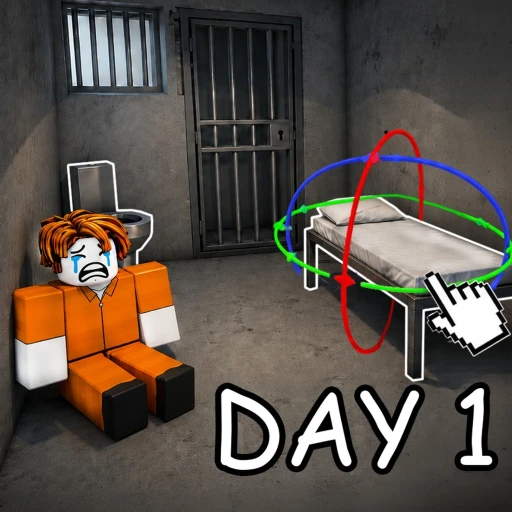
My Jail Cell turns a single prison cell into a survival base you build, barricade, and defend across repeating day/night cycles. While the sun's up you're safe, so you scavenge food, collect pets, drag furniture into your rooms, and gear up. Then night falls, monsters start roaming outside, and the whole game flips: now you hide, stay quiet, and try to make it to morning. This guide covers the survival loop, base-building priorities, monster behavior, the current state of codes, and how to bank real Robux on the side.
What's in this guide
Getting Started
My Jail Cell is a survival base-builder from ATTANIAN INDUSTRIES, and the premise is right there in the name: your starting point is a jail cell, and everything grows out from it. It's free-to-play, so you can load in on any device and start the first cycle right away.
The numbers say players are sticking with it. As of June 2026 the game has peaked at around 41,604 concurrent players, pulled in roughly 43 million visits, and sits near a 72% rating, with 24,049 likes against 9,259 dislikes. It also updates frequently, so rooms, monsters, and balance keep shifting between patches.
When you first spawn, you're standing in your cell with daylight on your side. That daytime window is your only safe period, and how you spend it decides whether your first night is survivable. Don't wander aimlessly. Treat each day as a checklist of jobs you need done before the light fades.
- Unlock and barricade a defensible room near your cell during the day.
- Scavenge the area for food and stockpile enough to outlast the night.
- Grab a weapon and keep it ready in case a monster corners you.
- Collect pets and customize your walls while it's still safe to move.
- Pick a hiding spot you can reach in seconds before dusk.
- When monsters spawn, stay quiet and hidden until morning.
Controls follow the standard Roblox layout. On PC you move with WASD or the arrow keys, interact with on-screen prompts to drag furniture, scavenge, and barricade, and the same actions map to touch buttons on mobile. The game runs fine on a phone, though the tense night phase is easier with a keyboard.

The Day/Night Survival Loop
Every cycle in My Jail Cell splits cleanly into two halves, and they ask completely different things of you. Understanding that split is the core skill the whole game tests.
Daytime is the safe phase. Nothing's hunting you, so this is when you do all your real work: scavenging food, collecting pets, dragging furniture into your base, unlocking new rooms, picking up gear and weapons, and customizing your walls. The clock is your only pressure. Everything you'll need at night has to be in place before the sun goes down.
Nightfall flips the script. Monsters roam outside your base, and the goal shifts entirely from building to staying alive. You hide, you stay quiet, and you avoid getting caught. There's no out-building this phase in the moment, so your survival depends on the prep you banked during the day.
Survive that night and you loop back to daytime, except now you've got a foothold. Each cycle you reinvest, expand the base, fortify more rooms, and gear up further. Over multiple day/night rounds, a single cell becomes a fortified compound you can actually defend.
The clock is the thing to respect. New players tend to lose track of time mid-task, look up, and realize the light's already fading with half their jobs unfinished. Build a habit of checking the daylight regularly and front-loading your most important task, usually barricading, so even a rushed day leaves you defensible. Treat the last stretch of daylight as a hard deadline to get into position, not a chance to squeeze in one more errand.
It also helps to think of each daytime as having a priority order rather than a to-do list. Barricades first, food second, weapon third, then pets and customization with whatever time's left. If you run that order every cycle, you're never caught at dusk missing the one thing that gets you killed.
Base-Building & Barricades
Your base is your answer to the night, and it's worth being deliberate about how you grow it. The mistake most new players make is spreading thin, unlocking lots of rooms but barricading none of them properly.
Start with one room. Unlock a single defensible space near your cell, ideally one with limited entrances, and pour your early effort into sealing it. Drag furniture into doorways and across sightlines to block and slow anything trying to reach you. A small, fully fortified room beats a sprawling base full of open gaps.
Furniture isn't just decoration here. Pieces you drag in double as barricades, so think about placement, not just looks. Once your core room is genuinely defensible, then you expand outward, unlocking and securing adjacent rooms one at a time so you never leave a weak link in the chain.
Fewer entrances is the whole trick. A room with one doorway is far easier to seal than one with three, because every opening is another thing monsters can come through and another spot you have to watch at night. When you're choosing which room to unlock first, count the entrances before you count the floor space. A cramped one-door room beats a roomy three-door one every time in the early cycles.
Layering matters too. Don't just block a doorway with a single object and call it done. Stack furniture so there's depth to the barricade, because a monster that pushes past one piece still has to get through the next. The rooms that hold up best at night are the ones where you've built a wall, not a speed bump, between you and the threat.
As your compound grows, plan the flow between rooms. You want a safe interior path that lets you reach food, gear, and your hiding spot without crossing an exposed opening. Build outward in a way that keeps your most-used rooms shielded behind your barricaded front line, rather than scattering important rooms where you'd have to expose yourself to reach them.

Surviving the Night
The night phase is where My Jail Cell earns the horror half of its survival label. Monsters roam outside once the light fades, and the rules for staying alive are simple to state and hard to execute under pressure.
Stay quiet. Noise draws monsters, so the moment night begins, stop sprinting around and settle into the spot you prepped during the day. Movement and sound are what get you caught, not standing still in a barricaded room.
Learn the patterns. Each monster has spawn timing and patrol behavior, and the players who clear nights consistently are the ones who've learned when a threat is near and when it's safe to reposition. Watch how they move during your first few nights, even if it costs you a run, because that knowledge pays off every cycle after.
Keep a weapon ready as your last resort. Hiding is the plan, but if a monster corners you, the weapon you grabbed during the day is what buys you a chance to break away. Don't rely on it as your main strategy, though. A good night is one where you never have to swing.
Manage your light and sightlines. If a monster can see you, it can come for you, so position yourself out of direct line from your room's entrances rather than standing in the open middle. Tuck into a corner or behind a barricade where you've got a clear view of the doorway but the doorway doesn't have a clear view of you. The goal is to spot the threat first and stay invisible while it passes.
Resist the urge to peek. The most common way players die at night is by breaking cover to check whether the coast is clear, making just enough noise or movement to draw a monster that was about to wander off. Trust your prep. Once you're hidden and quiet, the safest move is almost always to do nothing and let the patrol cycle through.
- Pick your hiding spot before dusk. Choose a place inside your barricaded room you can reach in seconds, not one you have to scramble for as the light dies.
- Stockpile food first. If you've banked enough food, you won't be forced out of cover to scavenge mid-night, which is when most players get caught.
- Don't make noise. Stay put and quiet once monsters spawn. Sound and movement are what give you away.
- Learn spawns and patrols. Knowing a monster's timing and route turns blind panic into calm, calculated waiting.
Tips & Strategies
Early game: lock down before you expand
Your first few cycles are fragile, so play tight. Unlock one room, barricade it fully, stockpile food, and grab a weapon before you touch anything cosmetic. The goal of the early game isn't a pretty base, it's clearing your first three or four nights without dying.
- Barricade one room completely. A single sealed room with limited entrances beats four half-open ones every time.
- Stockpile food before night. Bank enough to outlast the dark so you never have to leave cover to eat.
- Keep a weapon on you. It's your fallback if a monster finds your hiding spot.
- Reinvest in defenses, not skins. Spend on barricades and gear first; wall customization can wait.

Mid game: expand and play co-op
Once you're clearing nights reliably, start widening the base and bringing friends. Co-op is where My Jail Cell opens up. Split the daytime jobs so one player scavenges food while another barricades and a third hunts pets, and you'll have far more done before dusk than any solo run.
- Play co-op to cover more ground. Divide daytime tasks across the team to fortify more rooms before nightfall.
- Expand one room at a time. Unlock and fully secure each new room before opening the next, so there's never a weak link.
- Map the monster routes. By mid game you should know spawn timing well enough to move safely at night when you have to.
- Stack gear before cosmetics. Better weapons and storage carry you through harder nights; skins are a reward for later.
Late game: a self-sufficient compound
By the late game your goal shifts from surviving to barely noticing the night at all. A mature compound has multiple barricaded rooms, a food surplus that outlasts several nights, and gear stocked for emergencies, so a single bad night doesn't undo you. At this point you can finally pour resources into cosmetics and pets without putting yourself at risk.
Pets and customization are the payoff layer. Once your defenses are solid, hunting pets during the day and customizing your walls gives the base personality and a sense of ownership, and it's a good use of the daytime safety you've earned. Just keep the priority order intact: if a night ever goes badly, drop back to rebuilding defenses before resuming the fun stuff.
Keep an eye on noise sources you've added, too. As your compound fills with furniture and decoration, make sure nothing you've placed forces you into the open or blocks your safe interior path. A well-decorated base is great until a misplaced piece traps you in a sightline at the worst moment.
A note on frequent updates
My Jail Cell updates often, so the room list, monster behavior, gear, and game passes can shift between patches. New rooms and threats get added, balance changes, and the developer may adjust costs or add systems over time. Check the in-game shop and the ATTANIAN INDUSTRIES channels after any big update so nothing catches you off guard.
My Jail Cell Codes
Correction (August 19, 2026): an earlier version of this guide said My Jail Cell had never shipped a code-entry feature. That was wrong. The game does have a working redemption box: press B in-game and a panel headed CODES! opens, with a text field, a green Redeem! button and the printed line "Join our community server for codes!" We re-checked that panel on August 19, 2026 against in-game footage from two separate creators.
What has not changed is the code list itself. No My Jail Cell code has passed our two-source check as of August 19, 2026. One candidate is circulating — Sploing — but it comes from a single outlet and nothing independent corroborates it, so we are not publishing it as working. The redeem box is live and the list is empty.
Because that panel points players at the developer's Discord, codes here are most likely to arrive as Discord drops alongside an update. We keep the running list, the redemption steps and the rejected candidates on our dedicated My Jail Cell codes page — that is the owning page for code detail, and it is the first thing we update when something clears the gate.
Earning Real Robux
Surviving nights and fortifying your base is all free, and that's the point: you don't need to spend a thing to clear My Jail Cell. The game passes that do exist range from roughly 5 to 499 Robux and are mostly cosmetic, with a few convenience perks like extra storage or stronger starting gear. They're optional, never required.
Earn Free Robux with Earnaldo
Earnaldo lets you rack up real Robux by completing simple tasks, offers, and surveys, then withdraw straight to your account. It's a clean way to fund any optional pass or skin you want.
That keeps the two tracks separate and clean. Survive the nights for free, and if you want a cosmetic pass or extra storage, fund it with Robux you earned on the side rather than out of pocket.
If survival games are your thing, there's plenty more in the cluster. See how this one stacks up in our My Jail Cell vs Dead Rails comparison, or jump to the My Jail Cell hub for every article in one place. For more co-op survival and horror, our Dead Rails guide, Doors guide, and Piggy guide are worth a read.
Frequently Asked Questions
My Jail Cell is a day/night survival base-builder by ATTANIAN INDUSTRIES set around your own jail cell. By day you collect pets, scavenge food, gather gear, and expand and barricade rooms. At night monsters roam outside and you have to hide and stay quiet to survive.
My Jail Cell was made by ATTANIAN INDUSTRIES. As of June 2026 it has hit a peak of around 41,604 concurrent players, roughly 43 million visits, and about a 72% rating from 24,049 likes against 9,259 dislikes. The game is active and updated frequently.
My Jail Cell does have a working code redemption box — press B in-game to open the CODES! panel, which has a text field and a green Redeem! button. What it does not have is a verified code: as of August 19, 2026 no My Jail Cell code has passed our two-source check, and the one candidate in circulation, Sploing, is single-sourced. See our My Jail Cell codes page for the current list and the redemption steps.
Stockpile food and barricade at least one room before dusk, then keep a weapon ready and stay quiet once monsters spawn. Pick a hiding spot you can reach fast, avoid making noise, and learn each monster's patrol pattern so you know when it's safe to move.
No. The full survival loop is free and you progress by scavenging, building, and surviving nights. Game passes range from roughly 5 to 499 Robux and are mostly cosmetic, with a few convenience perks like extra storage or better starting gear. None of them are required to beat the night.
Unlock and barricade a single defensible room before anything else, ideally one with limited entrances. Drag furniture in to block sightlines and slow monsters, then expand outward once that core room is safe. Spend on defenses before cosmetics in the early cycles.
Co-op is generally easier because you can split daytime jobs, with one player scavenging food while another barricades and gears up. More hands means more rooms fortified before nightfall, which makes surviving the night much more manageable than playing solo.
Pets are collected during the safe daytime phase and act as a progression and customization layer alongside your base. Grab them while it's light out, since the night phase is for hiding rather than exploring, and fold pet hunting into your daytime scavenging route.

About This Guide
This guide is based on the live version of My Jail Cell as of June 16, 2026. Because the game updates frequently, rooms, monsters, gear, codes, and game passes can change with each patch, so check the in-game shop and the official channels for the latest. You can play it on its official Roblox page, where new content rolls out over time.