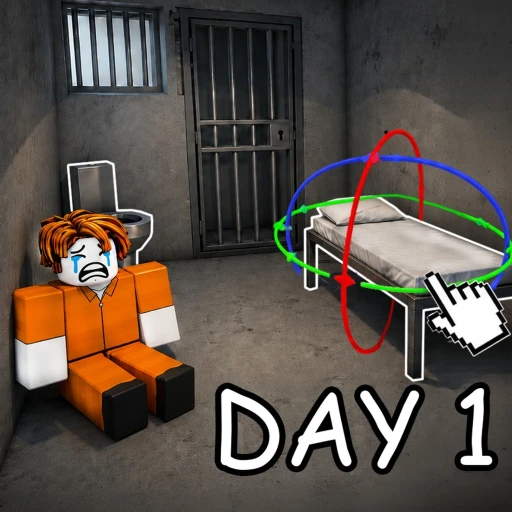
My Jail Cell vs Dead Rails (2026) -- Which Roblox Game Is Better?
Last checked August 19, 2026
Both of these are survival games, but they pull in opposite directions. My Jail Cell keeps you in one place, building and barricading a jail cell across day/night cycles and hiding from monsters when it's dark. Dead Rails throws you onto a runaway 1800s train that never stops, where you defend, scavenge, and fight through zombie country to reach the end of the line. This comparison breaks down stats, gameplay, co-op, horror style, and who each game is actually for, then lands on a verdict.
On this page
Quick Stats
Here's the snapshot before we get into the detail. Where current live numbers are uncertain, they're labeled as estimates as of July 2026.
| Feature | My Jail Cell | Dead Rails |
|---|---|---|
| Genre | Survival / horror base-builder | Co-op survival action |
| Developer | ATTANIAN INDUSTRIES | Independent Roblox team |
| Setting | Your jail cell, day/night cycles | Runaway 1800s train, zombie country |
| Core loop | Build, barricade, hide, survive the night | Ride, defend, scavenge, reach the end |
| Movement | Stationary base you fortify | Constantly moving train |
| Peak players | ~41,604 concurrent (July 2026) | Very large; a major 2025-2026 hit |
| Visits | ~43 million | Hundreds of millions (as of July 2026) |
| Rating | ~72% (24,049 likes / 9,259 dislikes) | Strongly positive (as of July 2026) |
| Cost | Free, optional passes ~5-499 Robux | Free, optional purchases |
Gameplay & Pacing
The biggest split between these two is motion. My Jail Cell is stationary. You anchor to a cell and grow outward, and the whole experience is about the place you're defending. Dead Rails never sits still. The train is always rolling toward the end of the line, and you're managing a moving platform under constant threat.
My Jail Cell runs on a rhythm. Daytime is safe and productive: you scavenge food, collect pets, drag furniture into rooms, unlock new spaces, and gear up. Nightfall flips it to pure survival, where monsters roam and you hide and stay quiet. That predictable swing between prep and panic gives you breathing room to plan, which some players love and others find slow.
Dead Rails has no safe phase. From the moment the run starts, zombies and hazards keep coming while the train pushes forward, so you're scavenging supplies, defending cars, and reacting in real time across one continuous escalating run. It's denser and more frantic, with the payoff being whether your group actually reaches the end.
That structural difference changes how a session feels. A My Jail Cell session is a series of distinct chapters, build, hunker down, survive, repeat, so you can pause mentally between threats and even step away during a calm daytime stretch. A Dead Rails run is one unbroken arc with no natural breathing point until the train reaches the end of the line or your group wipes, which makes it more committal but also more thrilling once it gets going.
Session length tells the same story. My Jail Cell rewards long, sprawling play where a base grows over many cycles, and it's just as happy with a short visit to clear a night or two. Dead Rails is built around the complete run as the unit of play, so you're signing up for the whole journey each time you start, which is fantastic when you've got the time and friends, and harder to dip into for five quick minutes.

Co-op & Multiplayer
Both games support playing together, but co-op means something different in each. In Dead Rails, teamwork is the foundation. A group shares the same train and has to coordinate defense, supply runs, and roles across the run, so a coordinated team massively outperforms a disorganized one. It's designed to be played with friends.
My Jail Cell supports co-op and genuinely benefits from it, but it doesn't require it. With teammates you can split the daytime jobs, one player scavenging food while another barricades and a third hunts pets, so you fortify more before nightfall. Solo is still completely viable, just slower and more demanding.
That difference matters for how you'll actually play. If you mostly queue alone, My Jail Cell respects that and stays fun. If you've got a squad ready, Dead Rails turns that group into the whole point of the experience.
Communication load is part of the picture. Dead Rails leans on real-time coordination, calling out threats, dividing supply runs, and deciding who holds which car, so it's most rewarding with voice chat or friends who already read each other well. My Jail Cell's co-op is lower-pressure: you can split daytime jobs with a quick plan and then mostly work in parallel, which makes it friendlier for playing with strangers or with a group that isn't tightly coordinated.
Failure also lands differently across a team. In Dead Rails a single mistake can cascade into a group wipe, so the stakes of teamwork are high and the lows are shared. In My Jail Cell, one player getting caught at night doesn't necessarily end the run for everyone, and the next daytime resets the slate, so the co-op feels more forgiving and less punishing of a weak link.
Horror & Tension
Both games are scary, but they scare you in different registers. My Jail Cell trades in quiet dread. At night you're hiding, holding still, and listening, where one wrong noise can bring a monster to your door. The tension is slow and personal, closer to a hide-and-survive horror game.
Dead Rails is action-horror. The fear comes from volume and chaos, waves of zombies, a train you can't stop, and split-second decisions about where to fight and what to grab. It's adrenaline rather than dread, and the pressure rarely lets up across a run.
Neither approach is objectively better. They're aimed at different moods. If you want to feel hunted in the dark, My Jail Cell delivers that. If you want a loud, frantic fight to the finish, Dead Rails is built for it.
The source of fear also differs. In My Jail Cell, the threat is something out there that you're trying not to attract, so the horror lives in anticipation and the dread of a single noise giving you away. In Dead Rails, the threat is already on you, and the fear comes from being overwhelmed, from the wave you can't quite hold or the supply you didn't grab in time. One makes you hold your breath; the other makes your pulse race.
Replay tone follows from that. After a tense My Jail Cell night, you exhale and rebuild, and the relief is part of the loop. After a chaotic Dead Rails run, win or lose, you're hyped to reset and try again immediately. If you play to unwind into slow tension, the first fits better; if you play to get your adrenaline up, the second wins.

Progression & Replay
The two games reward your time differently. My Jail Cell is about persistent buildup: across multiple day/night cycles you expand a single cell into a fortified compound, so progress feels like a base growing stronger session over session. The pull is seeing your defenses improve.
Dead Rails is run-based. Each attempt is a fresh push toward the end of the line, and replay value comes from improving your group's coordination, surviving longer, and finally completing the journey. It's a different satisfaction loop, built on getting better at the run rather than growing a base.
As for the numbers, Dead Rails is the bigger title overall, a standout survival hit of 2025-2026 with very large player counts as of July 2026. My Jail Cell is no slouch, peaking around 41,604 concurrent players with roughly 43 million visits and a 72% rating, which is strong for a frequently updated base-builder.
Longevity comes from different places. Dead Rails keeps you coming back through mastery, you want to beat your last run, survive deeper, and finally complete the line with a tighter team, which is the classic pull of a high-skill co-op challenge. My Jail Cell keeps you through investment, since the base you've grown over many cycles is a project you don't want to abandon, and each session adds to something that persists.
That also shapes who churns out and who stays. Players chasing a quick, repeatable thrill tend to favor Dead Rails' run loop, while players who like settling in, optimizing, and watching a place they built get stronger over time tend to stick with My Jail Cell. Neither model is better, but knowing which one matches your own play habits is the most useful predictor of which game you'll still be playing in a month.
Cost and fairness
Both games are free-to-play and built so that skill and teamwork, not spending, decide how well you do. In My Jail Cell the optional passes run roughly 5 to 499 Robux and lean cosmetic, with a few convenience perks like extra storage, none of which are required to clear a night. Dead Rails likewise keeps its purchases optional and to the side of the core challenge.
That matters for value. You can put dozens of hours into either game without spending a thing and never feel walled off from the real content. If you do choose to spend, you're buying flavor and a little convenience rather than power, which is the fair end of the free-to-play spectrum and a point in both games' favor.
The Verdict
Our Take
There's no single winner, because these games solve different cravings. Dead Rails is the bigger, more intense, more social experience, a relentless co-op run that's at its best with a coordinated squad and hard to put down. My Jail Cell is the more methodical, atmospheric pick, a build-and-hide survival loop with a satisfying day/night rhythm that plays great solo or with friends. Want chaos and teamwork? Dead Rails. Want tension, building, and pacing you control? My Jail Cell. Most survival fans will happily keep both installed.
Who Should Play What
Play My Jail Cell if...
- You like building and defending a base. Fortifying a cell across cycles is the heart of the game.
- You want a safe phase to plan. The daytime window lets you prep at your own pace before danger arrives.
- You often play solo. It's fully viable alone, with co-op as a bonus rather than a requirement.
- You prefer slow, quiet dread. Hiding and staying silent at night is the tension you're after.
Play Dead Rails if...
- You have a squad. Coordinated co-op is the whole point and where it shines brightest.
- You want nonstop action. There's no safe phase, just a moving train and relentless zombies.
- You like run-based replay. Each attempt is a fresh push to reach the end of the line.
- You want the bigger community. It's one of the defining survival hits of 2025-2026.
Earn Free Robux with Earnaldo
Whichever survival game you pick, Earnaldo lets you earn real Robux by completing simple tasks, offers, and surveys, then withdraw straight to your account for any optional cosmetic.
Want the full breakdown on either game? Our My Jail Cell guide and Dead Rails guide go deep on strategy. You can also browse everything in one place through the My Jail Cell hub and the Dead Rails hub.
Frequently Asked Questions
My Jail Cell is a stationary day/night base-builder where you fortify a jail cell and hide from monsters at night. Dead Rails is a moving co-op survival game set on a runaway 1800s train that you ride, defend, and push through zombie-infested territory toward the end of the line.
Dead Rails is the bigger hit overall, a major 2025-2026 survival success on Roblox with very large player numbers. My Jail Cell is also genuinely popular, peaking around 41,604 concurrent players with roughly 43 million visits and about a 72% rating as of July 2026.
Dead Rails is built around co-op, with a team defending and supplying the same train across a run, so coordination is central. My Jail Cell supports co-op too and benefits from it, letting players split daytime jobs, but it remains fully playable solo.
Both have a redemption system. My Jail Cell does have a code box — press B in-game and a CODES! panel opens with a text field and a green Redeem! button — but as of August 19, 2026 no My Jail Cell code has passed our two-source check, so the panel is live and the list is empty. (An earlier version of this page said the game had no code system at all; that was wrong.) Dead Rails has used codes at points in its life. For the current lists see our My Jail Cell codes page and our Dead Rails codes page. Neither game requires codes to progress.
They scare you differently. My Jail Cell leans into tense, quiet hiding at night where any noise can get you caught. Dead Rails delivers pressure through constant zombie waves and the chaos of defending a moving train, so it's more action-horror than slow dread.
My Jail Cell is gentler for newcomers because the safe daytime phase lets you prepare at your own pace before the danger arrives. Dead Rails throws you into a fast, lethal run quickly, which is thrilling but less forgiving, and it's most fun with a coordinated team.
No. Both games are free-to-play and built around skill and teamwork, not spending. Purchases in both are optional, leaning toward cosmetics and convenience, so you can fully enjoy and succeed in either without spending Robux.
About This Comparison
This comparison reflects both games as of June 16, 2026. My Jail Cell stats come from its live page, and Dead Rails details rely on well-known public facts about the title, with uncertain current figures labeled as estimates. Both games update over time, so check their pages: My Jail Cell on Roblox for the latest.