100 Days At Sea vs 99 Nights in the Forest (2026) -- Which Roblox Game Is Better?
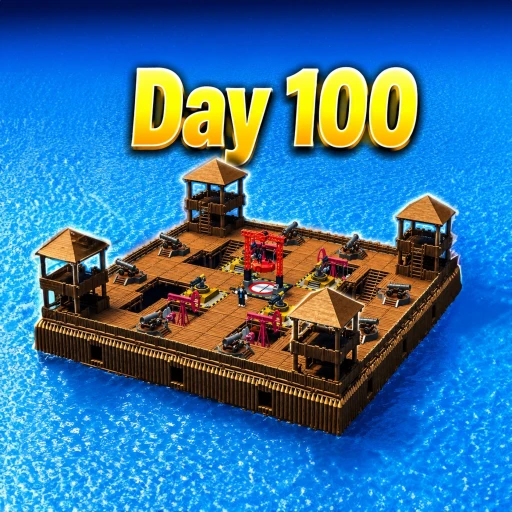
Two survival games, two completely different ways to die. 100 Days At Sea from Stranded Devs strands you in the middle of the ocean with a harpoon and a dream -- harpoon resources, build a raft, expand into a base, raid islands for weapons, and survive 100 days while unraveling the mystery of the Bermuda Triangle. 99 Nights in the Forest drops you into a dark woodland where the campfire is everything, the wolves never quit, and a creature called the Deer can erase a careless camp in seconds.
Both are free to play and both lean hard on the survival loop, but they pull in opposite directions. 100 Days At Sea is a calmer, exploration-first sandbox you set your own pace through. 99 Nights in the Forest is a tense, run-based co-op grind where the clock on your campfire never stops. This comparison breaks down every category that matters -- gameplay, progression, visuals, player counts, game passes, social play, and replay value -- so you can pick the right one, or just keep both in rotation.
100 Days At Sea vs 99 Nights in the Forest -- Quick Stats (2026)
| Category | 100 Days At Sea | 99 Nights in the Forest |
|---|---|---|
| Genre | Open-world ocean survival | Co-op forest night-survival horror |
| Place ID | 70411440483149 | 79546208627805 |
| Developer | Stranded Devs | Grandma's Favourite Games |
| Released | November 14, 2025 | March 2025 |
| Concurrent Players | ~650-1,000 CCU | ~328K-442K CCU (14.2M peak) |
| Total Visits | ~46M | 27B+ |
| Rating | 96.7% | Strong positive |
| Core Loop | Harpoon, build raft/base, explore islands | Fuel campfire, fight wolves, rescue children |
| Key Features | Bermuda Triangle mystery, weapons, base defense | Campfire system, taming, the Deer boss |
| Key Game Pass | Convenience/cosmetic (99-799R) | Decorator (199R, sometimes 79R) |
| Trading System | No formal player trading | No formal player trading |
| Run Structure | Persistent 100-day playthrough | Session-based nights, co-op squads |
| Mobile-Friendly | Yes | Yes |
| Free-to-Play | Yes | Yes |
Gameplay -- What Do You Actually Do?
100 Days At Sea
100 Days At Sea sends you into open water with one job: stay alive for 100 days and uncover what's hiding in the Bermuda Triangle. You start with almost nothing. The harpoon is your first real tool -- you hook floating crates, debris, and resources out of the water to gather the wood, scrap, and materials your raft is built from.
Base building is the heart of it. A flimsy raft becomes a real platform, then a fortified floating base with storage, crafting stations, and defenses. Exploration drives everything outward. Mysterious islands dot the map, and each one can hold weapons, loot, rare materials, or enemies that want you gone. Knowing when to push for an island and when to retreat to your raft is the core strategic call.
Combat matters more than the calm intro suggests. You find and craft weapons to defend your base and clear islands, and the deeper into your 100-day run you go, the more the ocean fights back -- storms, sharks, and hostile island threats escalate. The 96.7% approval rating from over 1,373 votes tells the story: players love that the difficulty ramps without ever feeling cheap, and that you control the pace.
99 Nights in the Forest
99 Nights in the Forest is survival with a stopwatch. Each run drops you into a procedurally generated forest, and the goal is to survive as many nights as possible while expanding your camp. The campfire is the single most important object in the game -- it burns fuel over time, and when it goes out, fog rolls in and damages everyone nearby. Keeping that fire lit is the constant background pressure behind every decision.
You upgrade the campfire in a strict order that gates your progress. Level 2 unlocks basic crafting like bandages and simple tools. Level 3 opens Pelt Trader access for swapping wolf pelts. Level 4 lets you explore the full map safely and enables the biofuel processor. Around day 7, rescuing children and building beds becomes the priority, because assigned children boost your camp's survival efficiency and feed the day multiplier that lengthens your productive daylight.
Then there are the threats. Wolves patrol the forest with a walkspeed of 23 and hit for 20 HP per attack, chasing relentlessly until they get too close to a lit fire. Cultists raid your camp, and the Deer -- the game's signature menace -- can devastate an unprepared squad. The taming flute lets you recruit wolves and eventually mammoths to fight back, turning enemies into bodyguards.
Edge: 100 Days At Sea for relaxed, self-paced exploration and base-building depth. 99 Nights in the Forest for tight, high-pressure survival with a constant fuel clock. The real question is whether you want freedom or tension.
Progression -- How Quickly Does It Hook You?
These two games hook you on completely different timelines. 100 Days At Sea is a slow-burn climb measured in literal in-game days. Your first hour is harpooning scrap and patching together a raft that barely floats. By day 30 you've got a real base, a weapon or two, and the confidence to raid your first island. By day 100 you're chasing the Bermuda Triangle payoff with a fortified platform and a stockpile -- a persistent run that reflects every hour you put in.
99 Nights in the Forest hooks faster and harder. Within the first night you understand the stakes: fuel the fire or die. The campfire upgrade ladder gives you clear, immediate milestones -- hitting Level 3 for the Pelt Trader feels like a real unlock, and reaching Level 4 to safely roam the full map changes how a run plays. Progression resets across runs, but mastery carries over, and squads chase higher night counts and bigger day multipliers each session.
The structural difference is persistence versus repetition. 100 Days At Sea rewards a single long investment, where your base is a monument to your time. 99 Nights rewards repeated runs, where each attempt is faster and cleaner than the last because you've learned the fuel math, the wolf timings, and the child-rescue routes. Neither is better in a vacuum -- they suit different attention spans.
Graphics and Audio
100 Days At Sea leans into open-ocean atmosphere. Sunlight glints off the water during calm stretches, and storms roll in with darkened skies and choppy waves that genuinely change how the sea feels. Islands break up the endless blue with distinct silhouettes, and your growing base gives the horizon a sense of home. The audio sells isolation -- lapping water, distant thunder, and the splash of your harpoon line.
99 Nights in the Forest gets its mood from darkness and dense woodland. Daylight filters through the canopy, then night plunges everything into a void where the campfire glow is the only safety. Beyond the firelight, shapes turn vague and threatening. Audio does heavy lifting here -- a branch crack might be wind, or the only warning before wolves rush your camp. Creature sounds scale in intensity as threats close in, training you to listen like a survivalist.
Edge: 99 Nights in the Forest. Both games look good for Roblox survival titles, but 99 Nights uses light, shadow, and sound design as active gameplay mechanics. The campfire-versus-darkness contrast and directional creature audio do more than set a mood -- they directly inform second-to-second decisions, which gives 99 Nights the more purposeful presentation.
Player Count and Community (July 2026)
99 Nights in the Forest is one of the biggest games on the entire platform. It hit a 14.2 million concurrent-player peak in 2025, still regularly runs between 328K and 442K CCU, and has racked up more than 27 billion total visits since launching in March 2025. Servers fill instantly, and the community is enormous -- wikis, tier lists, and constant fresh content keep the ecosystem buzzing.
100 Days At Sea is the underdog with the better scorecard per player. As a newer game from November 2025, it sits at roughly 650 to 1,000 concurrent players and around 46 million visits. Far smaller, but its 96.7% approval rating is exceptional, signaling a tight, satisfied player base that genuinely enjoys the slower survival loop rather than a crowd that churns through.
Community culture differs sharply. 99 Nights has the mass-appeal, meme-heavy energy of a top-charts game, with creators pumping out clip compilations and Deer-encounter highlights. 100 Days At Sea draws a more dedicated, exploration-minded crowd that shares base designs, island routes, and theories about the Bermuda Triangle story. One is a phenomenon; the other is a hidden gem with a loyal following.
Edge: 99 Nights in the Forest. On raw numbers there's no contest -- hundreds of thousands of concurrent players against a thousand is a different league entirely. If a packed server and an active community matter to you, 99 Nights wins decisively. 100 Days At Sea counters with a higher satisfaction rating, but scale belongs to 99 Nights.
Game Passes and Monetization
99 Nights in the Forest keeps monetization refreshingly light. The headline purchase is the Decorator pass at 199 Robux, which in some regions drops to 79 Robux. It spawns you in with a Paintbrush and a Hammer, gives you store discounts, and hands you an extra item every visit. That's the core paid offering, and crucially it doesn't gate survival -- the full night-by-night loop is free.
100 Days At Sea follows a more typical convenience-and-cosmetic model, with passes generally landing in the 99 to 799 Robux range. These lean toward quality-of-life boosts and cosmetic flair rather than hard pay-to-win advantages, keeping the survival challenge intact. As a newer title from Stranded Devs, its pass lineup is still expanding, and pricing can shift with updates.
Neither game forces you to spend to enjoy it, which is the most important thing. 99 Nights asks for less total Robux and keeps its store almost embarrassingly simple. 100 Days At Sea offers more optional purchases but stops short of locking core gameplay behind them.
Edge: 99 Nights in the Forest. The Decorator pass at 199 Robux (or 79 in some regions) is the cleaner, cheaper, more player-friendly setup. One affordable, mostly cosmetic pass beats a broader lineup for players who want to spend as little as possible while still getting the full experience.
Social Features
99 Nights in the Forest is co-op to its core. You play in squads of up to four, splitting duties -- one person fuels the fire and crafts, another gathers wood and scrap, a third hunts wolves or tames companions, and someone rushes the child rescues. The shared panic of a campfire running low while the Deer circles creates the kind of stories friend groups retell for weeks.
100 Days At Sea is far more of a personal survival journey. You can share the experience, but the raft-and-base loop is built around your own pace and your own decisions, with no teammate timer breathing down your neck. It's the better game for solo players or anyone who wants to wind down rather than coordinate.
Edge: 99 Nights in the Forest. The four-player co-op design, the division of labor, and the constant high-stakes communication make it the stronger social game by a wide margin. 100 Days At Sea is the better solo experience, but for a friend group looking for a regular survival night, 99 Nights is built for exactly that.
Replay Value
99 Nights in the Forest is engineered for replays. Every run uses a procedurally generated forest, so the map, resource spread, and threat layout shift each time. You chase higher night counts, better day multipliers, and cleaner campfire-upgrade routes, and the co-op variety means a run with four friends feels nothing like a tense solo attempt. The constant updates from Grandma's Favourite Games keep adding reasons to come back.
100 Days At Sea offers a different kind of longevity. A single 100-day playthrough is a long, persistent arc, and finishing it is its own achievement. Replays come from trying new base layouts, exploring islands you skipped, hunting the full Bermuda Triangle mystery, and pushing for a more efficient survival run. It's deep, but it's a deliberate, slower kind of replay rather than the rapid-fire restarts of 99 Nights.
Edge: 99 Nights in the Forest. Procedural generation plus co-op variety plus a fast restart loop makes it inherently replayable session after session. 100 Days At Sea has genuine depth and a satisfying long arc, but 99 Nights gives you a fresh, unpredictable run every single time you load in.
Earning Free Robux While You Play
Both games have natural downtime that pairs well with earning Robux on the side. 100 Days At Sea has calm stretches between island runs while you build and gather, and 99 Nights in the Forest has daytime phases where threats ease off before the next brutal night. For game-specific strategies, check our 100 Days At Sea free Robux guide and our 99 Nights in the Forest free Robux guide. For more on the ocean survival game, the 100 Days At Sea hub collects everything in one place.
Earn Free Robux for 100 Days At Sea or 99 Nights in the Forest
Complete simple tasks on Earnaldo and withdraw real Robux -- no generators, no downloads. Put your earnings toward game passes in either game.
Head-to-Head Verdict -- 100 Days At Sea vs 99 Nights in the Forest in 2026
The Verdict
Choose 100 Days At Sea if you want a calmer, exploration-driven survival sandbox you can play at your own pace. The harpoon-to-base progression is satisfying, the Bermuda Triangle mystery gives your 100-day run a real destination, and the 96.7% approval rating reflects how much its players love the slower, self-directed loop. It's the better pick for solo play and for anyone who wants survival without a constant timer.
Choose 99 Nights in the Forest if you want fast, high-tension co-op survival with friends and servers that fill instantly. The campfire fuel system, escalating wolf and Deer threats, taming, and child rescues create relentless pressure, and the 328K-plus concurrent players mean you'll never wait for a match. It's the stronger social game and the more replayable one thanks to procedural generation.
Overall: 99 Nights in the Forest is the bigger, more replayable, more social game -- and on scale alone it's the obvious mainstream winner. But 100 Days At Sea isn't trying to win on size. Its higher rating, relaxed pace, and exploration depth make it the better solo wind-down survival game. The honest answer for many players is both: 99 Nights for group nights, 100 Days At Sea for solo sessions.
Who Should Play What?
- You love exploration and base building: 100 Days At Sea, because the raft-to-fortified-base arc and island-hopping reward curiosity at your own pace.
- You want fast-paced co-op tension: 99 Nights in the Forest, because the campfire clock and escalating night threats keep a four-player squad on edge.
- You are a solo player: 100 Days At Sea, because the survival loop is built around personal pacing with no teammate pressure.
- You want instantly full servers: 99 Nights in the Forest, because its 328K-plus concurrent players mean zero wait time.
- You create content: 99 Nights in the Forest for viral clips and Deer encounters, or 100 Days At Sea for long-form base tours and mystery theories.
- You want to earn Robux: Both work with Earnaldo.
Frequently Asked Questions
99 Nights in the Forest is far larger. It peaked at 14.2 million concurrent players in 2025, regularly pulls between 328K and 442K CCU, and has passed 27 billion total visits since March 2025. 100 Days At Sea is a newer November 2025 game with roughly 650 to 1,000 concurrent players and around 46 million visits, but it carries a higher 96.7% approval rating. 99 Nights wins on scale; 100 Days At Sea wins on rating.
100 Days At Sea is open-world ocean survival -- you harpoon resources, build a raft and base, explore islands, find weapons, and uncover the Bermuda Triangle mystery over a 100-day run. 99 Nights in the Forest is a tighter, run-based forest survival game where you keep a campfire fueled, fight wolves and the Deer, rescue children, and survive escalating nights. One is sprawling exploration; the other is tense night-by-night defense.
99 Nights in the Forest keeps it minimal with the Decorator pass at 199 Robux, sometimes discounted to 79 Robux in certain regions, which adds a Paintbrush, Hammer, store discounts, and an extra item each visit. 100 Days At Sea sells convenience and cosmetic passes typically in the 99 to 799 Robux range. 99 Nights has the cleaner, cheaper monetization, and neither game locks core survival behind a paywall.
Both support solo play. 100 Days At Sea is genuinely enjoyable alone because raft and base building is a personal, paced experience with no timer pressure from teammates. 99 Nights in the Forest is playable solo but noticeably harder, since one player has to fuel the campfire, gather resources, and fend off wolves and the Deer all at once. 99 Nights is built around co-op squads of up to four.
99 Nights in the Forest has the steeper difficulty curve because the campfire fuel timer never stops and night threats escalate fast -- wolves hit for 20 HP and the Deer can wipe an unprepared camp. 100 Days At Sea is more forgiving early on since you set your own pace gathering and building, though storms, sharks, and island enemies ramp up the deeper into the 100 days you go. 99 Nights punishes mistakes faster.
If you want a calmer, exploration-driven survival sandbox where you build a raft and uncover a mystery at your own pace, start with 100 Days At Sea and its 96.7% rating. If you want fast-paced, high-tension co-op survival with friends and instantly full servers, start with 99 Nights in the Forest -- its 328K-plus concurrent players mean you'll never wait for a match. Many players keep both: 100 Days for solo wind-down, 99 Nights for group nights.