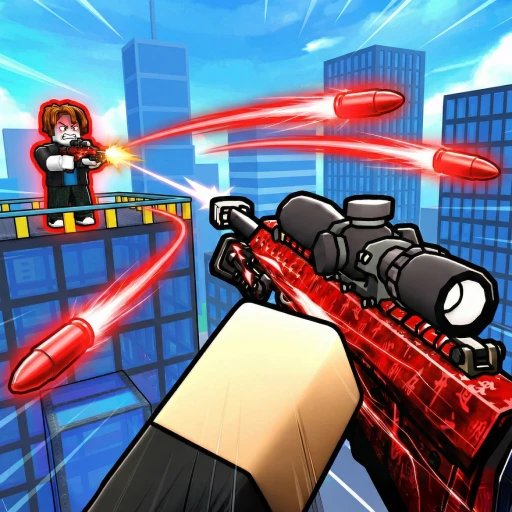
Hypershot vs The Strongest Battlegrounds (2026) -- Which Roblox Game Is Better?
Hypershot and The Strongest Battlegrounds are both serious competitive games on Roblox, but they couldn't be more different. One is a projectile-based arena shooter where you slide-cancel through firefights and stack ability loadouts. The other is an anime fighting game where you chain melee combos and unleash screen-filling ultimates. Together they've accumulated over 2.5 billion total visits and regularly stack 50,000+ concurrent players between their lobbies.
The question isn't which game is objectively better -- it's which one fits your playstyle. This comparison breaks down every category that matters: combat feel, game modes, ranked systems, player counts, monetization, mobile performance, and community. By the end, you'll know exactly where your time should go. For deeper dives into each game, check out the Hypershot hub page and the The Strongest Battlegrounds hub page.
Hypershot vs The Strongest Battlegrounds -- Quick Stats (2026)
| Category | Hypershot | The Strongest Battlegrounds |
|---|---|---|
| Genre | FPS Arena Shooter | Anime Fighting / PvP Brawler |
| Developer | Frosted Studio (PhoenixSigns) | nuketown studios |
| Total Visits | 500M+ | 2B+ |
| Concurrent Players | ~15K | ~35K |
| Combat Type | Projectile-based (hitscan + projectile) | Melee combos + special moves |
| Health System | 100 HP + 50 Shield | Large HP pool, varies by character |
| Ability System | Freeform: choose 3 abilities per loadout | Character-locked: unique movesets per fighter |
| Game Modes | TDM, FFA, CTF, Gun Game, Duels, Golden One | Open arena PvP, ranked 1v1 |
| Ranked System | 7 tiers: Bronze to Radiant (persistent) | Arena ranking with matchmaking |
| Weapons / Characters | 46 weapons | Multiple anime-inspired characters |
| Key Monetization | Hacker Bundle (2,400 R$ / 340 R$ on sale) | Character and cosmetic game passes |
| Free-to-Play | Yes | Yes |
| Mobile-Friendly | Playable (movement tech very hard on touch) | Playable (combos harder on touchscreen) |
The Strongest Battlegrounds more than doubles Hypershot's concurrent player count at peak hours. But the gap in experience is even larger than the gap in numbers -- these games ask completely different things from you as a player, and reading the raw numbers alone won't tell you which one to install first.
Gameplay -- Projectile Arena vs Anime Brawler
Hypershot: Fast Projectile Combat
Hypershot is a fast-paced arena shooter built around projectile combat, movement tech, and freeform loadout construction. You enter a match, pick a primary weapon, a secondary, and three abilities, then drop into a map where every engagement lasts between 1 and 4 seconds. The pace is relentless. Players who aren't slide-canceling or using abilities to reposition are standing targets.
The 100 HP plus 50 Shield health system creates a two-phase dynamic in every fight. Shields regenerate after 4 seconds off combat, so the game punishes you for backing off after half-winning a fight. You strip someone's 50 shield, and if you disengage, they reset to full defense. This mechanic rewards pushing through kills rather than playing cautiously -- which matches the game's aggressive overall tempo perfectly.
What separates Hypershot from a standard Roblox shooter is the ability layer. You might run Tailwind for a burst dash to close distance, Photon Shield to block incoming fire during a repositioning move, and Regen Splash to heal mid-fight. These aren't passive bonuses -- they're active tools with cooldowns that skilled players weave into the rhythm of every engagement. The combination space across 46 weapons and the full ability pool means two players can run completely different builds and both succeed at high rank.
The Strongest Battlegrounds: Melee Combo Fighter
The Strongest Battlegrounds drops you into an open arena where you pick an anime-inspired fighter and look for opponents to beat. Combat runs on light attacks, heavy attacks, special moves, and ultimate abilities that combine into combo strings. When you land a full combo sequence on an opponent, it feels genuinely satisfying -- the animations are clean, the screen feedback is punchy, and the damage output makes every landed combo count.
Each character plays differently. Their combo routes, range, damage output, movement options, and ultimate abilities all vary by fighter. Learning one character well takes 5 to 10 hours of focused play. Learning the matchup against every character in the roster takes considerably longer. Top TSB players develop punish windows, combo extensions, and defensive reads that beginners don't know exist. The game doesn't hand you these tools -- you develop them through repetition.
The open arena format means there's no round structure in the traditional sense. You roam, find opponents, fight, lose or win, and immediately look for the next fight. Rematches are constant and encouraged. The social rhythm of challenging someone, adapting to their playstyle across multiple fights, and eventually winning the runback is a big part of why TSB keeps its players for hundreds of hours.
Edge: Hypershot for players who prefer ranged combat, weapon variety, and structured game modes. Edge: The Strongest Battlegrounds for players who want melee depth, anime character fantasy, and an organic competitive environment without queue systems.
Combat Depth and Skill Expression
How Deep Does Hypershot Go?
Hypershot's skill ceiling lives primarily in two areas: movement tech and loadout optimization. The core movement technique is the slide-cancel bunny hop -- sprint, press C to slide, jump immediately out of the slide, sprint again on landing. Executing this chain consistently moves you faster than normal sprinting while making your hitbox bounce unpredictably. Every player above Gold rank in Hypershot's ladder uses this. Against someone who's mastered it, the difference in survivability is dramatic and visible.
On top of movement, abilities add a strategic layer that goes beyond pure mechanical execution. Knowing when to pop Photon Shield to absorb a burst of incoming fire, when to hold Tailwind for an escape versus burning it aggressively for position, and how to sequence Regen Splash between fights -- these decisions separate mid-rank players from Diamond and Radiant competitors. The Barrett sniper deals 300 damage per shot and one-shots anyone whose shield is down, so reading when opponents have cracked shields and exploiting that window is a core high-level skill.
The loadout system adds another dimension. There are 46 weapons spanning assault rifles, SMGs, shotguns, snipers, and miscellaneous picks including the Tomato launcher (AoE splash) and Minigun (750 DPS with a movement trade-off). Figuring out which weapon pairings work for your playstyle, which abilities complement them, and how to adjust based on what the lobby is running keeps experienced players engaged across hundreds of hours. See the Hypershot game page for a current weapon tier list breakdown.
How Deep Does TSB Go?
The Strongest Battlegrounds is deep in a way that's both wide and tall. Wide because each character has a completely different set of tools, meaning mastery of one fighter doesn't fully transfer to another. Tall because even within a single character, the execution difficulty scales dramatically -- there are basic combos any player can land in their first hour, and there are extended combo routes with precise timing windows that take weeks to execute consistently under pressure.
Frame data matters in TSB in ways most Roblox games ignore. Some moves are safe on block and can be thrown out freely. Others leave you open for a full combo if they whiff or get blocked. Knowing which of your moves fall into each category, and learning the same for the opponent's character, is the knowledge grind that separates good TSB players from dangerous ones.
Movement tech exists in TSB as well. Dash canceling, jump canceling out of certain moves, and using movement abilities to extend combos or escape losing situations all contribute to the ceiling. A player using only basic attacks and occasional specials is leaving significant damage and safety potential on the table.
Edge: The Strongest Battlegrounds for total combat depth and mechanical breadth across the full character roster. Hypershot's ceiling is extremely high within its movement-and-loadout framework, but TSB's combination of character variety and combo depth creates more total learnable material overall.
Game Modes
Hypershot's Six Modes
Hypershot ships with six game modes: Team Deathmatch, Free-For-All, Capture the Flag, Gun Game, Duels, and Golden One. TDM and FFA cover the bread-and-butter experience for most players. CTF adds objective teamwork without the overhead of a complex mode. Gun Game cycles you through random weapons with each kill, which is genuinely useful as a practice tool since it forces you to perform with guns outside your usual rotation.
Duels is the standout mode for competitive-minded players who want pure 1v1 skill tests with no teammates to mask personal weaknesses. Golden One puts a bounty on the top-performing player in the lobby, creating organic king-of-the-hill pressure inside a deathmatch format. Both modes are excellent for grinding individual skill. For active promo codes that can help you unlock skins before jumping in, the Hypershot codes page keeps the latest working ones updated.
TSB's Open Arena Structure
The Strongest Battlegrounds uses an open arena format rather than discrete queued modes. You load in, roam the map, and find opponents. The primary progression activity is fighting other players, winning, and accumulating experience. There's no CTF, no Gun Game, no Capture objectives -- just combat against whoever is willing to fight.
The ranked system provides a more structured competitive context. You enter ranked matchmaking, get paired with players at similar skill, and fight to accumulate rating. This is the closest TSB gets to a formal mode structure, and it's where the game's competitive identity lives for serious players. Casual players who prefer varied objectives and shorter defined rounds will find Hypershot's mode roster more satisfying. Players who want pure combat without mode overhead will prefer TSB's open format.
Edge: Hypershot for mode variety and players who want structured, objective-based or format-varied gameplay. TSB's open arena works well but offers less variety in how you interact with the game from session to session.
Ranked Systems
Hypershot Ranked: Seven Persistent Tiers
Hypershot's ranked system uses seven tiers: Bronze, Silver, Gold, Platinum, Diamond, Master, and Radiant. You earn or lose SR based on match results, with wins as the primary driver and individual performance as a secondary modifier. Ranks are persistent -- they don't reset between seasons, so the progress you build carries forward indefinitely. Climbing from Bronze to Gold takes most committed players a few days of consistent play. Pushing into Diamond and above requires mastering slide-cancel movement, maintaining a positive kill/death ratio against increasingly skilled opponents, and making smart ability decisions mid-fight.
The persistent structure means you're never thrown back to rank one after a seasonal reset, and your rank reflects real accumulated skill. The downside is that the top end of the ladder can become stagnant, with the same group of Radiant players holding those positions over long stretches. For players who track their rating day-to-day, this creates meaningful long-term progression with visible milestones to chase. The Hypershot free Robux guide has additional tips on climbing ranked efficiently alongside unlocking cosmetics.
TSB Ranked: Arena Matchmaking
The Strongest Battlegrounds has a ranking system that pairs you with opponents of similar skill in its arena matchmaking. Unlike Hypershot's fixed 7-tier structure, TSB's ranking sits more in the background for most players -- the primary competitive drive comes from the organic challenge of the open arena, where you're constantly measuring yourself against whoever is in the lobby that session.
Formal ranked play in TSB rewards both mechanical execution and matchup knowledge. Winning consistently at high rank requires knowing your character's punish windows, executing your best combos under pressure, and adapting to an opponent's tendencies over the course of a set. Players who put in the training time see their rank reflect it. For active codes that unlock cosmetics before grinding, the The Strongest Battlegrounds codes page lists the current working promos.
Edge: Hypershot for a more structured, visible ranked progression system with defined tier milestones. TSB's ranking works but the open arena format means most competitive players measure themselves informally rather than focusing on a specific number climbing toward a named rank.
Progression and Unlockables
Hypershot
Hypershot's progression runs through weapon unlocks, ability access, and cosmetic items. Most of the 46 weapons are available to free players with enough time invested, and the ability pool doesn't require Robux purchases to access. The ranked system itself provides a progression framework -- climbing from Bronze toward Radiant is a clear, measurable goal that keeps players invested across weeks and months of play.
Cosmetic progression comes through gameplay currency and Robux bundles. The Hacker Bundle at 2,400 Robux (frequently discounted to 340 Robux on sale) is the main cosmetic offering and represents solid value when discounted. The Brainrot Bundle at 125 Robux is a low-cost entry point for players who want some personalization without a significant spend. None of these purchases affect combat performance -- someone running default gear can beat someone with every cosmetic unlocked if they're the better player.
The Strongest Battlegrounds
TSB progression centers on character mastery and unlocks. Some characters are available immediately, while others require either accumulated in-game currency or Robux to access. The real progression, though, is internal and skill-based. You don't unlock a stronger version of your character by grinding -- you unlock it by becoming better at the character you already have. This is a meaningful design choice that keeps the competitive landscape fair regardless of how much time or money someone has invested.
Cosmetic options come through character skins and visual effects. Seasonal updates periodically add new cosmetics that create short-term incentives to grind or spend. The overall monetization is comparable to Hypershot: cosmetic-focused, free players can access full competitive capability, and paying accelerates cosmetic acquisition rather than combat power.
Edge: Tied. Both games respect free players and tie cosmetics to Robux rather than combat advantage. Hypershot gives you more explicit measurable progression through its ranked ladder. TSB's skill-based internal progression is equally meaningful but less numerically trackable on a day-to-day basis.
Graphics, Style, and Performance
Hypershot and The Strongest Battlegrounds have distinctly different visual identities that match their gameplay philosophies.
Hypershot uses a stylized, high-energy arena aesthetic. Maps are designed for visual clarity first -- you need to spot enemies quickly during chaotic firefights, so the environments are clean, color-coded, and free of distracting clutter. Ability effects are neon and punchy without obscuring the action. Performance holds well on mid-range hardware, though heavy team fights with multiple abilities firing simultaneously can cause brief frame drops on older mobile devices.
The Strongest Battlegrounds leans into anime visual language. Character designs are detailed, special moves have elaborate animations, and ultimates come with dramatic screen effects that communicate the power of each ability. The visual design rewards the player fantasy -- landing a full combo and watching the character's ultimate trigger feels genuinely cinematic. On the downside, ability effects during multi-player fights can create visual noise that makes reading the battlefield harder. Performance costs are moderate but manageable on most devices running Roblox.
Audio tells a similar story. Hypershot's sound design is functional and competitive-focused -- gunfire, ability cues, and footsteps all provide tactical information. TSB's audio leans into anime-style punchy sound effects that make combat feel impactful and satisfying rather than providing the same tactical depth. Neither approach is wrong; they're optimized for different player goals.
Edge: The Strongest Battlegrounds for visual identity and satisfying combat feedback. Hypershot wins on visual clarity during combat and performance consistency across a wider range of devices.
Monetization
Neither game is pay-to-win. Both are free to play with cosmetic-only or character-unlock monetization. The structures differ in meaningful ways, though.
Hypershot sells bundle packages rather than individual items or a VIP game pass. The Hacker Bundle lists at 2,400 Robux full price but regularly goes on sale for 340 Robux -- that sale price is one of the better cosmetic deals in Roblox when it's active. The Brainrot Bundle at 125 Robux is accessible even for players with modest Robux budgets. There are no XP-boost passes, no pay-gated weapons, and no paid progression accelerators. Your rank reflects your skill, not your spending habits.
The Strongest Battlegrounds sells individual game passes that unlock specific characters or cosmetic enhancements. Some characters sit behind a Robux paywall rather than being earnable purely through gameplay time. This isn't a pay-to-win arrangement -- the characters available to free players are fully competitive -- but it does mean players who want access to every fighter in the roster will spend more over time than a Hypershot player who just wants cosmetics.
If you're using Earnaldo to earn free Robux, Hypershot's cosmetic bundles represent better value per Robux, particularly at sale prices. For specific code savings before you spend anything, check the Hypershot codes page and The Strongest Battlegrounds codes page for active promos on both games.
Edge: Hypershot for a cleaner free-to-play model where every gameplay element is accessible without spending. TSB's character paywalls are fair but represent a broader spend requirement over time for completionists who want the full roster.
Player Count and Community (July 2026)
The Strongest Battlegrounds is the larger game by a significant margin. At roughly 35,000 concurrent players, it sits more than double Hypershot's average of 15,000 CCU. TSB has crossed 2 billion total visits; Hypershot has cleared 500 million. In raw scale, it's not a close comparison.
What that means practically: TSB's lobby fills instantly regardless of mode, time zone, or hour of day. You'll never wait for opponents in an open arena that large. Hypershot's 15,000 CCU is still more than enough for zero-wait queues in TDM and FFA -- the core modes are always populated. Niche modes like Duels or CTF might require 30 to 60 seconds during off-peak hours, which is a minor inconvenience at most.
Community character differs noticeably between the two. TSB draws players who are deeply invested in the fighting game competitive scene -- Discord servers with formal matchmaking channels, tier list debates, combo showcase content, and occasional community tournaments are all common. YouTube and TikTok creation is active, with combo montages and character breakdowns regularly hitting six-figure view counts. The community skews toward dedicated competitors who've put in hundreds of hours.
Hypershot's community is smaller but cohesive. The Discord leans heavily on ranked competition discussion, loadout theory, and movement tech guides. Because the player base is tighter, you'll recognize recurring opponents in ranked lobbies after a few weeks of consistent play, which creates a genuine sense of community that large anonymous games lack. If you like building a reputation among regular competitors and having rivalries that persist across sessions, Hypershot's scale is actually an advantage.
Edge: The Strongest Battlegrounds for sheer community size, content ecosystem, and competitive scene breadth. Hypershot wins for players who prefer a tight-knit competitive environment where individual players stand out and rivalries develop naturally.
Mobile Experience
Both games are playable on mobile through the Roblox app, but neither is optimal on touchscreens due to their competitive mechanics.
Hypershot is genuinely difficult on mobile. The slide-cancel bunny hop that every serious player uses requires precise keyboard timing -- sprint, slide key, jump, sprint again in rapid sequence. Replicating this on a touchscreen is close to impossible at the speed required in real matches. Mobile players running Hypershot will find themselves at a structural disadvantage against PC players in every ranked lobby. The game is still playable for casual TDM and FFA, but competitive play on mobile is an uphill battle that gets steeper the higher you try to climb.
The Strongest Battlegrounds is more functional on mobile, though executing extended combo strings is harder without a keyboard. Basic attacks and simple special move usage translate reasonably well to touchscreen inputs. The slower in-fight pacing compared to Hypershot's constant movement requirement means mobile players have more time to register inputs and respond to opponents. Serious TSB players still benefit strongly from a controller or keyboard, but the gap between mobile and PC is narrower than in Hypershot.
Edge: The Strongest Battlegrounds for mobile players. If you're primarily playing on a phone or tablet, TSB gives you a more competitive experience than Hypershot's movement-tech-dependent meta allows.
Earning Free Robux for Either Game
Both Hypershot and The Strongest Battlegrounds have worthwhile cosmetics and character passes to spend Robux on. If you'd rather not pay out of pocket, Earnaldo lets you earn free Robux by completing simple tasks -- surveys, app trials, and similar offers. Hypershot's Brainrot Bundle at 125 Robux is achievable in a single Earnaldo session. The Hacker Bundle at 340 Robux (sale price) takes a few sessions. TSB character passes typically run in the 100 to 400 Robux range depending on the fighter.
For step-by-step strategies on maximizing earnings alongside your play sessions, check the Hypershot free Robux guide and the The Strongest Battlegrounds free Robux guide. Both pages include current pricing and tips for getting the most Robux value per hour on Earnaldo.
Earn Free Robux for Hypershot or TSB
Complete simple tasks on Earnaldo and withdraw real Robux for bundles, character passes, and cosmetics in either game.
Head-to-Head Verdict -- Hypershot vs The Strongest Battlegrounds in 2026
The Verdict
Choose Hypershot if you want fast-paced arena shooting with deep movement tech, a freeform loadout system across 46 weapons, structured game modes including 1v1 Duels, and a persistent ranked ladder to climb. It's the better choice for players who enjoy projectile combat, ability synergies, and grinding a visible rank progression. The slide-cancel bunny hop gives the game a skill ceiling that rewards hundreds of hours of dedicated practice.
Choose The Strongest Battlegrounds if you want melee combo depth, anime character fantasy, and a thriving open-arena competitive scene. TSB's character roster, combo system, and visual identity make it one of the most distinct Roblox games in its genre. It's the better choice for players who prefer fighting game mechanics, enjoy anime aesthetics, or want the larger community and more active content ecosystem.
Overall: These games target fundamentally different players and complement each other well as a pair. Hypershot is for the FPS competitive grinder who wants structured modes, weapon theory, and movement mastery. The Strongest Battlegrounds is for the fighting game enthusiast who wants combo expression, character variety, and an organic competitive environment. Many players enjoy both and switch based on mood. If you're brand new to competitive Roblox and had to pick one, TSB's larger community and slightly gentler entry curve make it the default recommendation -- but Hypershot will hook you faster once the movement clicks.
Who Should Play What?
- You enjoy projectile-based shooting: Hypershot, because its arena combat and 46-weapon arsenal are built entirely around ranged projectile and hitscan mechanics.
- You want anime-themed melee fighting: The Strongest Battlegrounds, because its character designs and combo system are built around anime inspiration that no other Roblox game matches.
- You play on mobile: The Strongest Battlegrounds, because its combat pacing is more forgiving of touchscreen input delays than Hypershot's movement tech demands.
- You want structured ranked progression: Hypershot, because its 7-tier persistent system from Bronze to Radiant gives you a clear, measurable ladder with named milestones to chase.
- You want the larger community and more content: The Strongest Battlegrounds, because 35,000 average CCU and 2 billion visits translate to instant queues, more YouTube content, and a broader competitive scene.
- You want the cleanest free-to-play model: Hypershot, because every gameplay element is accessible without spending, and its cosmetic bundles frequently go on deep sale at 340 Robux from a 2,400 list price.
- You love building loadouts and theorycrafting: Hypershot, because choosing weapons, pairing abilities, and adjusting builds between matches is a core part of the game's identity.
- You want to earn Robux for either game: Both work with Earnaldo -- see the Hypershot guide or TSB guide for specific strategies.
Frequently Asked Questions
The Strongest Battlegrounds is more popular by a clear margin. It averages around 35,000 concurrent players and has crossed 2 billion total visits. Hypershot sits at roughly 15,000 concurrent players with 500 million visits. Both games maintain active communities, but TSB has more than double the live player count at any given moment.
Both have steep skill curves but in different areas. Hypershot demands movement tech mastery -- the slide-cancel bunny hop is nearly mandatory in ranked and very hard to learn quickly. TSB requires learning combo strings, frame data, and matchup knowledge across multiple characters. Hypershot is harder to pick up initially due to movement requirements; TSB takes longer to fully master because of how much character-specific knowledge it demands.
Both run on mobile through the Roblox app. The Strongest Battlegrounds is the more viable mobile option -- its pacing gives you more time to register inputs, and basic combat is functional on a touchscreen. Hypershot's slide-cancel movement tech is nearly impossible to execute on a phone, putting mobile players at a serious disadvantage in every ranked lobby. For mobile-primary players, TSB is the clear recommendation.
The Strongest Battlegrounds wins here without contest. Every character is an anime-inspired fighter with movesets, visual effects, and ultimates that reference popular series. The entire game's identity is built around the anime fighting game genre. Hypershot has no anime theming whatsoever -- it's a western-style arena shooter with no character or story influence from anime source material.
Hypershot has the more developed formal ranked system, with 7 persistent tiers from Bronze to Radiant that carry across seasons and provide clear measurable progression. The Strongest Battlegrounds has ranked arena matchmaking that works well competitively, but most TSB players measure their skill through open-arena performance rather than a formal ladder. If structured rank climbing is what you're after, Hypershot is the better choice.
The Strongest Battlegrounds is slightly more accessible for newcomers because basic attacks deal meaningful damage without requiring movement tech execution. You can participate and improve at your own pace in the open arena. Hypershot's fast time-to-kill and movement-heavy meta means beginners die frequently before understanding the game's systems. That said, TSB becomes difficult quickly once you face experienced combo players, so neither is a gentle introduction -- but TSB gives you more room to breathe in the early hours.