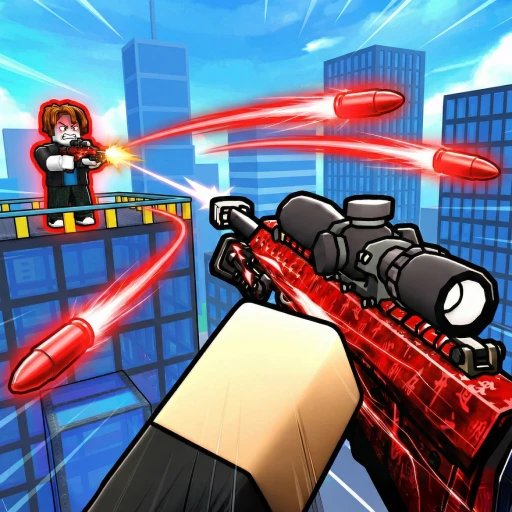
Hypershot vs Violence District (2026) -- Which Roblox Action Game Should You Play?
Two of the most popular action experiences on Roblox right now approach combat from completely different angles. Hypershot is a lightning-fast arena FPS built on Quake-speed movement and Overwatch-style abilities, where every round tests raw mechanical skill. Violence District drops you into an asymmetrical horror match where five survivors scramble to repair generators while a single overpowered killer hunts them down. Both games pull massive concurrent player counts, and both revolve around intense action. That is where the overlap ends.
If you have been scrolling through Roblox trying to decide which of these two deserves your next gaming session, this comparison covers everything you need to make that call. We break down the gameplay loops, skill ceilings, progression systems, social features, and long-term staying power of both games so you can invest your time wisely. We have spent hundreds of matches across both -- fragging lobbies in Hypershot and running from killers in Violence District -- to give you a thorough, honest breakdown.
Quick Stats Comparison
| Category | Hypershot | Violence District |
|---|---|---|
| Genre | Arena FPS / Shooter | Asymmetrical Horror (5v1) |
| Avg. Players | ~26,000 concurrent | ~65,000 concurrent |
| Developer | Frosted Studio (PhoenixSigns) | VIOLENCE DISTRICT |
| Release Date | 2024 | October 31, 2024 |
| Platform | PC, Mobile, Console | PC, Mobile, Console |
| Core Loop | Shoot, outmaneuver, climb ranks | Survive or hunt, repair or kill |
| Game Modes | TDM, FFA, CTF, Gun Game, Duels | Survivor vs Killer (5v1) |
| Weapons / Killers | 46 weapons across 5 categories | 10+ killers with unique abilities |
| Ranked System | 7 tiers (Bronze to Radiant) | No formal ranked mode |
| Perk / Ability Count | Dozens of abilities, 3 per loadout | 38 survivor perks, 10 killer perks |
Gameplay and Core Loop
Hypershot -- Speed Kills
Hypershot is an arena shooter that rewards mechanical precision above everything else. You spawn into a match with your chosen loadout -- one primary weapon, one secondary, and three abilities picked from a deep pool -- then immediately start hunting for kills. The game modes range from Team Deathmatch and Free-for-All to Capture the Flag, Gun Game, and 1v1 or 2v2 duels. Every mode boils down to the same fundamental question: can you aim better and move faster than everyone else in the lobby?
The movement system is where Hypershot separates itself from other Roblox shooters. Slide canceling -- pressing Ctrl while sprinting to slide, then immediately jumping to cancel the slide into a low, fast hop -- preserves momentum while making you a nightmare to track. Top players chain these cancels together to cross open sightlines at absurd speed, and learning this tech is basically mandatory if you want to compete at higher ranks. The movement has a rhythm to it that feels closer to Quake or Titanfall than anything you would normally find on Roblox.
Every player starts each match with 100 HP and 50 Shield, giving 150 total effective health. Shields regenerate automatically after 4 seconds of not taking damage, but HP only comes back through specific abilities like Regen Splash. This creates a push-and-pull dynamic where aggressive players must commit to fights knowing that chip damage sticks, while defensive players can play angles and let their shields recover between engagements.
The weapon variety is staggering for a Roblox game. Forty-six weapons span five categories -- assault rifles, SMGs, shotguns, snipers, and miscellaneous -- each with distinct recoil patterns, damage profiles, and optimal engagement ranges. The May 2026 Traits update added a new layer of weapon customization, letting you attach upgrades that modify how your guns perform. Paired with the Awakening system, weapon progression now has genuine depth that keeps grinders engaged long after they have found their favorite loadout.
Violence District -- Tension by Design
Violence District takes a fundamentally different approach to action. Inspired by Dead by Daylight, every match pits five survivors against one killer in a high-stakes game of cat and mouse. Survivors must repair five generators scattered across the map to power the exit gates, then escape before the killer catches and sacrifices them all. The killer's job is to hunt, down, hook, and eliminate every survivor before the generators are finished.
As a survivor, the gameplay is built around tension rather than firepower. You do not fight back -- you run, hide, use pallets to stun the killer, and work together with your team to repair generators as efficiently as possible. The repair mechanic involves skill checks that appear as quick-time events during generator work, and failing them alerts the killer to your position. Good survivors learn the maps inside out, know every loop and pallet location, and can extend chases long enough for their teammates to finish objectives.
Playing killer is an entirely different experience. Each killer has a unique ability kit that changes how you approach the hunt. The Hidden excels in stealth with invisibility when stationary and a Mark ability that lunges long distances while revealing hit survivors. The Abysswalker brings strong mobility with parrying and corruption effects. The newest addition, The Cure -- a plague doctor-themed killer added in the May 2026 update -- specializes in laying traps and transforming caught survivors into minions. At 15,000 Screws, The Cure is the most expensive killer in the game, but the unique trap-and-convert playstyle is unlike anything else in the roster.
The perk system adds strategic depth for both sides. Survivors can equip perks that speed up generator repairs, reveal the killer's location briefly, or grant a burst of speed after being hit. Killers get perks that slow generator progress, expose survivor auras, or enhance chase ability. With 38 survivor perks and 10 killer perks available as of mid-2026, mobility and information perks dominate the current meta, but there is real build variety that rewards experimentation.
Edge: Hypershot for raw mechanical skill expression and mode variety. Violence District for tension, teamwork, and strategic depth.
Skill Ceiling and Learning Curve
Hypershot -- Aim Is Everything
The skill ceiling in Hypershot is among the highest of any Roblox game. At the top end, you are dealing with players who have mastered slide-cancel chains, can flick between targets with pixel-perfect accuracy, and use abilities with frame-perfect timing to secure kills that seem physically impossible. The ranked system reflects this with seven tiers: Bronze (top 30%), Silver (25%), Gold (20%), Platinum (15%), Diamond (7%), Master (2.5%), and Radiant (0.5%). You earn or lose SR based on match results, and performance metrics like K/D ratio affect SR gains starting at Gold.
The learning curve hits new players hard. If you have never played a fast-paced FPS before, your first few hours in Hypershot will involve dying constantly to players who seem to materialize out of thin air, fire twice, and vanish. Understanding weapon recoil, optimal engagement distances, ability cooldown management, and movement tech all need to click before you start winning gunfights consistently. There is no tutorial that teaches you how to chain slide cancels or when to pop Photon Shield versus saving it for a retreat.
That said, the skill expression is what keeps players coming back. Every kill you earn feels like your kill. There is no randomness, no luck-based mechanic that saves you or dooms you. If you lose a gunfight, you got outplayed, and you can watch the replay to understand exactly what went wrong.
Violence District -- Knowledge Over Mechanics
Violence District's skill ceiling is more about game knowledge than mechanical ability. You do not need god-tier aim to be an excellent survivor -- you need map awareness, loop knowledge, generator priority understanding, and the ability to read the killer's behavior in real time. A survivor who knows every pallet location, every window vault, and every shortcut on a given map will survive far longer than one with fast reflexes but no map sense.
Killer gameplay has a higher mechanical demand, since you need to track survivors during chases, predict their movements, mind-game them at pallets, and manage your unique ability cooldowns while maintaining map pressure. The best killers understand when to commit to a chase and when to break off to apply generator pressure elsewhere. It is a constant decision-making process that rewards experience and adaptability over raw reaction speed. The S-tier killers in the current meta -- The Hidden, The Abysswalker, and The Veil -- each require dozens of hours to play at a competitive level.
New players will find the survivor role accessible from the start. You can contribute to generator repairs immediately, and even if you go down early, you can still learn the maps and killer patterns while spectating teammates. The killer role is harder to pick up, since a bad match as killer means getting looped for five minutes without a single hook while all five generators get completed around you.
Edge: Hypershot has the higher raw skill ceiling. Violence District rewards game knowledge and strategic thinking over mechanical execution.
Map and Environment Design
Hypershot -- Arenas Built for Flow
Hypershot's maps are designed around the movement system. Every arena features interconnected sightlines, verticality, flanking routes, and cover placement that rewards players who understand how to rotate through the space efficiently. Good map knowledge means knowing where the power positions are, which angles control key areas, and how to use slide cancels to reach unexpected positions before your opponents can react.
The arenas vary in size depending on the game mode. Free-for-All maps tend to be tighter with more frequent engagements, while Team Deathmatch maps offer wider layouts with distinct lanes and chokepoints. Capture the Flag maps feature mirrored designs that balance offense and defense. Visually, Hypershot leans into a futuristic, neon-lit aesthetic that keeps the action readable even at high speeds. Enemy outlines, hitmarkers, and damage indicators are all clearly communicated, so you can focus on gameplay rather than squinting at the screen trying to figure out where shots are coming from.
Violence District -- Maps That Create Fear
Map design in Violence District serves a completely different purpose: generating tension. Every environment is built around loops, dead zones, and generator placements that force survivors into risky positions. Tight indoor corridors create claustrophobic chases where you can hear the killer's heartbeat audio getting louder as they approach. Sprawling outdoor areas with dense cover let you hide, but also give the killer long sightlines to spot movement from a distance.
Each map has its own generator layout, pallet placements, and loop structures that experienced players memorize over time. Knowing where the strong loops are -- the areas where a survivor can extend a chase for the longest time -- is essential for high-level play. Equally important is understanding the dead zones, areas with no pallets or windows where getting caught means going down almost immediately. The maps also rotate, so you cannot always predict which environment you will be playing in, forcing adaptability and rewarding players who learn multiple maps rather than specializing in just one.
Edge: Tie. Both games have maps designed specifically for their core gameplay. Hypershot prioritizes competitive clarity and flow. Violence District prioritizes atmosphere and tension.
Progression and Customization
Hypershot -- Loadout Depth and Ranked Climbing
Progression in Hypershot runs along two parallel tracks. The first is your ranked climb through the seven competitive tiers from Bronze through Radiant. You earn or lose SR based on match results, with performance metrics starting to affect SR gains once you hit Gold and above. This gives competitive players a clear, measurable goal to work toward every session, and the rank distribution ensures that climbing feels meaningful at every stage.
The second track is loadout progression. With 46 weapons to experiment with, three ability slots to fill, and the new Traits and Awakening systems for weapon customization, there is a massive amount of build variety to explore. Finding the weapon combination that matches your playstyle -- whether that is an assault rifle for mid-range consistency, a shotgun for aggressive slide-cancel plays, or a sniper for long-range picks -- takes time and experimentation. Abilities like Tailwind for quick repositioning, Photon Shield for holding angles, and Infinity Edge for burst damage each open up different tactical approaches that change how you play each match.
Cosmetic progression comes through weapon skins and character customization. These are purely visual and have zero impact on gameplay, which keeps the competitive integrity intact. You earn some cosmetics through gameplay milestones and ranked rewards, while premium skins are available through bundles.
Violence District -- Unlocking the Roster
Violence District's progression centers on unlocking killers, survivors, and perks. New killers cost Screws -- the in-game currency earned through gameplay -- with prices scaling up to 15,000 for The Cure, the most expensive character in the game. Each killer plays differently enough that unlocking a new one genuinely changes your gameplay experience, which makes the grind feel worthwhile rather than padded.
Perk progression is where the real build-crafting happens. As you play more matches, you unlock and level up perks for both survivor and killer roles. Building a perk loadout that synergizes with your playstyle and the current meta takes experimentation and game knowledge. The addition of perks like Finesse in late 2025, and ongoing balance patches throughout 2026, keep the meta shifting enough that optimal builds change over time. Mobility perks dominate right now for both sides, but information perks that reveal the killer's location or expose survivor auras can swing entire matches in the right hands.
Cosmetic customization includes killer and survivor outfits that let you personalize your appearance without affecting gameplay balance. Event-exclusive cosmetics tied to updates like the SCP crossover and The Cure release give players who participate during launch windows items that become increasingly rare over time.
Edge: Hypershot for competitive progression depth with its ranked ladder and weapon trait system. Violence District for meaningful character unlocks that change how you play the game.
Social Features and Multiplayer
Hypershot -- Built for Competition
Hypershot's social features revolve around competitive play. The 1v1 and 2v2 duel modes let you challenge friends directly, settling arguments about who has better aim in the most definitive way possible. Team Deathmatch and Capture the Flag reward communication and coordination, with organized teams consistently outperforming random lobbies full of solo players.
The ranked system creates a natural social ecosystem. Players at similar skill levels run into each other repeatedly, building rivalries and friendships through repeated matches. At higher ranks, the community becomes tight-knit, with players recognizing each other's playstyles and adjusting their approach based on who they are facing. The competitive scene around Hypershot has grown steadily throughout 2026, with community tournaments and content creators driving engagement beyond the standard ranked grind.
The weapon skin trading economy adds another social layer. Rare skins carry real value in the trading community, and building a collection of sought-after items gives the game a collecting dimension for players who enjoy that side of Roblox culture.
Violence District -- Teamwork Under Pressure
Violence District creates social bonds through shared tension -- and that is meant in the best way possible. Nothing brings a group of survivors together faster than being chased by The Hidden while your teammate clutches a last-second generator repair to open the gates. The 5v1 format means that four of your five teammates are on your side, creating a natural cooperative dynamic that fosters communication and trust.
Playing with a coordinated survivor group is a fundamentally different experience from solo queue. Friends can split up to pressure generators across the map, call out the killer's location and movement direction, and coordinate saves when someone gets hooked. The difference between a random team and a coordinated squad is enormous, making Violence District one of the strongest group experiences on Roblox for friend groups of three to five players.
The killer experience is inherently solo, which appeals to a different type of player. There is a unique satisfaction in outsmarting a coordinated survivor team through mind games, map control, and ability usage. Killer mains often develop their own subcommunity within the broader Violence District player base, sharing strategies, build recommendations, and tier list debates for specific killers and perk combinations.
Edge: Hypershot for competitive multiplayer and direct skill-based rivalry. Violence District for cooperative teamwork and shared memorable moments.
Performance and Accessibility
Hypershot demands more from your hardware than most Roblox games. The fast-paced action with multiple players, ability effects, and projectiles flying across the screen can cause frame drops on older devices, especially during chaotic Team Deathmatch matches with full lobbies. The game runs best on PC where you also get the advantage of mouse-and-keyboard aiming, which is a significant edge over controller and touchscreen players. Mobile is playable but noticeably harder -- executing slide cancels and tracking targets on a touchscreen puts you at a real disadvantage in cross-platform lobbies.
Violence District runs smoother across the board. The slower pace of gameplay, smaller player count per match (six total), and less visually demanding combat effects mean that mobile players can enjoy the full survivor experience without major performance issues. Survivor gameplay translates well to touchscreen controls since the primary inputs are running, interacting with generators, and vaulting -- none of which require precision aiming. Killer gameplay on mobile is more challenging due to the need for quick camera movements during chases, but it remains viable for casual play.
Both games support PC, mobile, and console. If you are primarily a mobile player, Violence District will give you a more competitive experience since the control gap between platforms is much smaller than in Hypershot, where mouse-and-keyboard players have a clear mechanical advantage.
Monetization
Hypershot keeps its monetization clean. Weapon skins and cosmetic bundles make up the entirety of purchasable content, with nothing that gives paying players a gameplay advantage. All 46 weapons, all game modes, all maps, and the full ranked system are free. The competitive integrity is airtight -- when someone eliminates you in Hypershot, you know it was skill and positioning, not a purchased advantage. This strictly cosmetic approach has contributed to the game's strong approval rating among its player base.
Violence District takes a similar approach with cosmetic-focused monetization. Killer and survivor outfits are available for purchase, and some premium cosmetics are tied to limited-time events like the SCP crossover. New killers are unlocked through Screws earned by playing, not through direct Robux purchases. The Cure costs 15,000 Screws, which represents a meaningful time investment, but that grind is the game itself -- you are playing matches and improving your skills while earning the currency you need.
From a free-to-play perspective, both games are generous. You can reach the highest ranks in Hypershot and unlock every killer in Violence District without spending a single Robux. Neither game creates situations where paying players have a tangible advantage in actual gameplay, which is increasingly rare on the Roblox platform.
Long-Term Staying Power
Hypershot's longevity comes from the ranked grind and the endless pursuit of mechanical mastery. There is always a higher rank to reach, a new weapon combo to experiment with, and a better player to learn from. The competitive nature of the game means that no two matches play out the same way, since human opponents are always adapting and improving. The Traits system added in May 2026 gave veteran players a fresh reason to revisit weapons they thought they had mastered, and the regular addition of new weapons and abilities keeps the meta from stagnating.
Violence District's staying power is tied to its killer roster and perk variety. Every new killer changes the dynamic of every match, since survivors must learn new counterplay strategies and killers must master new ability kits. The Cure's trap-and-convert playstyle, for example, forced the entire survivor meta to shift away from grouping up for rescues. The horror atmosphere also gives the game a unique emotional hook -- the tension of hearing a killer approaching never gets old, even after hundreds of hours, because the stakes of each match feel genuinely high.
Both games have active development teams pushing regular updates. Hypershot's competitive community drives content creation and tournament play that extends engagement beyond just solo queue grinding. Violence District's community generates its own content through killer tier lists, survivor strategy guides, and the shared experience of surviving or failing to survive particularly intense matches.
The Verdict
Hypershot and Violence District are both outstanding Roblox games that serve completely different player desires. Hypershot is for players who want to test and improve their mechanical skills in a competitive FPS environment, where every match is a direct measure of your aim, movement, and decision-making under fire. Violence District is for players who want atmospheric tension, strategic teamwork, and the thrill of asymmetrical gameplay where one side holds all the power and the other side has to outsmart them to escape. If you love the rush of landing a perfect headshot while slide-canceling through an arena, Hypershot is your game. If you love the heart-pounding tension of crouching behind a wall while a killer searches the room you are in, Violence District owns that space completely. Many players keep both in rotation -- Hypershot when they want fast-paced competitive action and Violence District when they want something that gets their heart rate up in a completely different way.
Who Should Play What?
Pick Hypershot if you:
- Love competitive FPS games and want to prove your aim on Roblox
- Enjoy mastering movement tech like slide canceling and momentum management
- Want a ranked ladder with clear tiers from Bronze through Radiant
- Prefer multiple game modes (TDM, CTF, FFA, Gun Game) for variety
- Play primarily on PC where mouse-and-keyboard gives you full control
Pick Violence District if you:
- Enjoy horror games and the tension of being hunted by another player
- Prefer strategic, knowledge-based gameplay over pure aim mechanics
- Want a strong cooperative experience for your friend group of three to five
- Like playing both sides of an asymmetrical dynamic -- hunter and hunted
- Play on mobile and want a game that works well on touchscreen controls
For more tips on getting the most out of either game, check out our Hypershot free Robux guide and Violence District free Robux guide. If you are already deep into the Roblox FPS scene, our Rivals guide covers another top-tier shooter worth your attention.
Earn Free Robux for Either Game
Whether you are saving up for a premium weapon skin in Hypershot or a new killer cosmetic in Violence District, Earnaldo lets you earn Robux by completing simple tasks. No surveys, no scams -- just real Robux delivered to your account.
Frequently Asked Questions
Violence District is easier to pick up as a survivor. The core loop of repairing generators, hiding, and running from the killer is straightforward, and you can contribute to your team from your very first match by working on generators even if you go down early. Hypershot has a steeper learning curve with slide-cancel movement tech, weapon recoil patterns, and ability cooldown management that take real practice to master. New Hypershot players will get outgunned by veterans consistently until they build foundational aim and movement skills.
Hypershot has more raw gameplay variety with 46 weapons across five categories, dozens of abilities, multiple game modes including Team Deathmatch, Free-for-All, Capture the Flag, Gun Game, and duels, plus a seven-tier ranked system and the new Traits weapon upgrade system. Violence District counters with a growing killer roster where each character has unique abilities, 38 survivor perks, 10 killer perks, and rotating maps with distinct layouts. Both receive frequent updates throughout 2026, with Hypershot adding the Traits system and Violence District releasing The Cure killer in May.
Yes, both games support mobile devices. Hypershot's fast-paced gunplay with slide canceling, precision aim tracking, and ability combos is significantly harder on a touchscreen, and you will be at a real disadvantage against PC players in cross-platform lobbies. Violence District translates better to mobile since survivor gameplay involves running, hiding, and interacting with generators rather than precision aiming. Playing killer on mobile is more challenging due to the need for quick camera movement during chases, but it remains a viable way to play casually.
It depends on your group's energy. Hypershot is excellent for competitive friend groups who enjoy FPS games, with 2v2 duels and team modes where callouts and coordination give you an edge. Violence District is outstanding for groups of three to five friends who want to coordinate as survivors, calling out killer positions, timing generator repairs, and executing clutch rescues together. The cooperative tension of Violence District creates shared stories that friends talk about long after the match ends, while Hypershot delivers the satisfaction of outplaying rival teams as a unit.
Neither game requires Robux to access the core experience. Hypershot monetizes through cosmetic weapon skins and bundles with zero gameplay impact -- all 46 weapons, all modes, and the full ranked system are free. Violence District sells cosmetic outfits for killers and survivors, while new killers are unlocked through Screws earned by playing matches rather than through Robux purchases. Both are fully playable without spending anything, and neither game gives paying players a competitive advantage over free players.
Both games receive regular updates in 2026. Hypershot recently added the Traits system for weapon upgrades alongside new weapons, abilities, and balance adjustments. Violence District dropped the Cure Update in May 2026 with a new plague doctor killer, additional perks, and quality-of-life improvements, following the earlier SCP crossover event. Both development teams maintain active update schedules, respond to community feedback, and keep their respective metas fresh with balance patches and new content drops.