Pistol Arena vs RIVALS (2026) -- Which Roblox Shooter Should You Play?
Pistol Arena and RIVALS both live in the Roblox shooter category, but they could not be more different. One strips gunplay down to its absolute core with one-hit kill pistols in chaotic free-for-all lobbies. The other builds a full tactical FPS experience with agents, abilities, objective modes, and a thriving ranked scene. Picking the wrong one means spending hours in a game that does not match how you want to play.
Pistol Arena, developed by Virtuals Games, launched as a beta title that exploded to over 52 million visits on the back of a single, addictive premise: everyone gets a pistol, every shot kills, and the last player standing wins. The game has pulled 13,600 concurrent players at its peak and currently holds steady around 5,200 active players. It sits at an 81.6% approval rating, which is strong for a game still in active development.
RIVALS, developed by RIVALS Studios, is the established heavyweight. With over 3 billion total visits, roughly 375,700 concurrent players, and an approximately 88% approval rating, it has cemented itself as one of the top competitive FPS experiences on Roblox. Team-based gameplay, multiple weapon classes, agent abilities, and a full seasonal ranked system give it a depth that few Roblox shooters match.
This comparison breaks down everything that matters: gameplay mechanics, movement systems, competitive features, player counts, monetization, and community health. By the end, you will know exactly which game deserves your time. For individual deep dives, check the Pistol Arena guide and the RIVALS free Robux guide.
In This Comparison
Pistol Arena vs RIVALS -- Quick Stats (2026)
| Category | Pistol Arena | RIVALS |
|---|---|---|
| Genre | FFA One-Hit Pistol Shooter | Competitive Team-Based FPS |
| Developer | Virtuals Games | RIVALS Studios |
| Place ID | 87018676608089 | 17625359962 |
| Total Visits | ~52.9M | 3B+ |
| Concurrent Players | ~5,200 (peak 13.6K) | ~375,700 |
| Approval Rating | 81.6% | ~88% |
| Kill System | One-hit kill | Standard HP pool |
| Primary Format | Free-for-All | Team-based (5v5, etc.) |
| Weapons | Pistols with progression unlocks | Multiple classes (rifles, SMGs, snipers, etc.) |
| Movement Tech | Bunnyhopping, sliding | Standard tactical (walk, sprint, crouch) |
| Ranked Mode | Not yet available | Full seasonal ranked system |
| Agent/Ability System | None | Agent abilities per class |
| Development Stage | Beta | Fully released, regular updates |
| Free-to-Play | Yes | Yes |
| Mobile-Friendly | Good (simple controls, short fights) | Playable (demands sustained precision) |
The stats tell two completely different stories. RIVALS is a massive, established platform with tens of times more players and visits. Pistol Arena is a fast-growing beta with a fraction of the player base but a laser-focused gameplay loop that hooks people immediately. The raw numbers favor RIVALS by an enormous margin, but numbers alone do not capture why thousands of players choose Pistol Arena every day over every other shooter on the platform.
Gameplay -- One-Hit Simplicity vs Tactical Depth
Pistol Arena
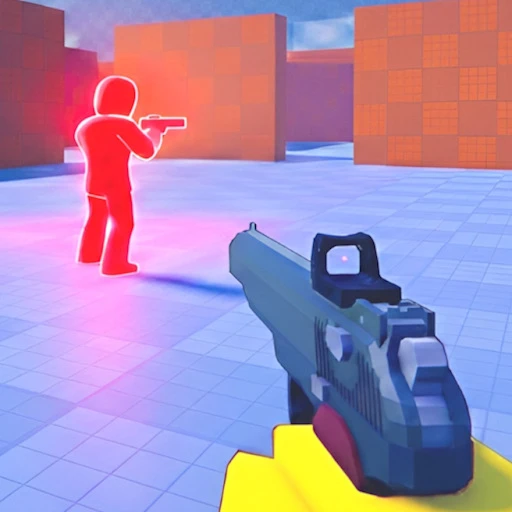
Pistol Arena strips the FPS genre down to its bones. You spawn into a free-for-all lobby with a pistol. One shot from any pistol kills any player instantly. There are no hitpoints, no shields, no healing, and no second chances. You see an opponent, you click, and one of you dies. The entire game revolves around who aims faster, moves better, and positions smarter in the split second before a fight starts.
This one-hit kill design creates a unique tension that no multi-hit shooter can replicate. Every corner you turn could end your streak instantly. Every time you hear footsteps behind you, the fight is already half over. There is no "trading damage" or "retreating to heal." You either land your shot first or you respawn. This binary outcome compresses every engagement into a pure test of reaction time and cursor placement.
The FFA format amplifies the chaos. There are no teammates to bail you out, no callouts to rely on, and no one watching your back. Every player in the lobby is hunting you and each other simultaneously. Awareness matters as much as aim because the player who kills you is often someone you never saw coming. Surviving long enough to stack kills requires constant 360-degree threat assessment while maintaining the mechanical precision to win each duel.
Weapon progression adds a layer of depth beneath the simple surface. As you play and accumulate kills, you unlock access to different pistols with varying characteristics. Some pistols fire faster, some have tighter spread, and some reward different playstyles. The progression system gives you a reason to keep grinding beyond just climbing the leaderboard, and it introduces subtle strategic choices about which pistol to use in different situations.
RIVALS
RIVALS goes the opposite direction by stacking systems on top of systems. You pick an agent, each with a unique set of abilities. You select weapons from a full arsenal of rifles, SMGs, shotguns, snipers, and sidearms. You coordinate with your team across objective-based modes where communication and role fulfillment matter as much as raw aim. The game demands you learn maps, understand economy management within matches, and develop game sense across dozens of variables.
Gunfights in RIVALS unfold over longer time frames than Pistol Arena. Players have standard health pools, meaning you need to land multiple shots to secure a kill. Recoil patterns differ across weapons and need to be learned individually. Headshots deal bonus damage but do not instantly kill in most cases. This creates extended engagements where aim consistency, spray control, and movement during firefights all contribute to the outcome. A fight that lasts two seconds in Pistol Arena might play out over five to eight seconds in RIVALS.
Agent abilities introduce another dimension entirely. Smoke grenades block sight lines. Flash abilities blind opponents holding angles. Recon abilities reveal enemy positions through walls. Healing abilities sustain your team through extended pushes. Every ability creates a decision point for both the user and the opponents. Using a smoke correctly can win a round. Wasting it can cost your team the entire match. This ability layer sits on top of the gunplay and gives RIVALS a strategic depth that pure aim-based games cannot match.
Team coordination is the defining feature. Five players working together, each filling a specific role, executing a planned strategy, and adapting in real-time when things go wrong. The satisfaction of a well-executed site take in RIVALS involves multiple players using abilities in sequence, trading kills, covering each other's angles, and defusing or planting under pressure. Nothing in Pistol Arena replicates that feeling because nothing in Pistol Arena involves teamwork at all.
Edge: Pistol Arena for immediate satisfaction and pure mechanical skill testing. Edge: RIVALS for depth, teamwork, and long-term strategic growth. This split is fundamental and defines which player each game serves.
Movement & Skill Ceiling
Pistol Arena's Movement System
Pistol Arena features a movement system built around bunnyhopping and sliding that creates a surprisingly high skill ceiling for a game with such simple core mechanics. Bunnyhopping lets you chain jumps to maintain and build speed beyond normal movement. Sliding drops your profile lower to the ground while maintaining forward momentum, making you harder to hit during transitions between cover points.
The combination of bunnyhopping and sliding turns movement into a core combat skill rather than just a way to get from point A to point B. Good Pistol Arena players are constantly in motion, chaining slides into bunnyhops into direction changes that make their hitbox difficult to track. Since every shot kills, making yourself even slightly harder to hit can be the difference between a five-kill streak and an instant respawn. Players who stand still or move predictably get destroyed by anyone with basic movement skills.
The skill ceiling here is deceptive. The game looks simple on the surface because the controls are minimal and the rules are straightforward. But the gap between a player who walks in straight lines and a player who chains movement tech while maintaining perfect crosshair placement on targets is massive. High-level Pistol Arena gameplay looks like controlled chaos: players flying across the map at high speed, hitting flick shots mid-bunnyhop, and sliding behind cover the instant after firing.
RIVALS' Movement Design
RIVALS uses a grounded, tactical movement model. You walk, sprint, crouch, and lean. There is no bunnyhopping, no slide mechanic, and no movement tech that lets you move faster than the base sprint speed. Sound design matters because sprinting produces audible footsteps that opponents can use to track your position. Walking is quieter but slower. Crouching reduces noise further and tightens your accuracy but makes you an easier target if caught in the open.
This design philosophy means the skill expression in movement comes from decision-making rather than execution. Knowing when to sprint versus walk, when to crouch-peek an angle versus wide-swing it, when to rotate early versus hold your position. These choices determine outcomes in RIVALS more than any mechanical movement technique. A player with average aim but excellent positional awareness will consistently outperform a player with great aim but poor movement decisions.
Ability-based movement adds some dynamics. Certain agents have dash abilities or movement speed boosts that temporarily break the standard movement rules. These abilities operate on cooldowns and must be used strategically. They do not create the same constant high-speed gameplay that Pistol Arena's movement tech enables, but they add clutch moments where a well-timed dash can save your life or secure a kill you would not otherwise get.
Edge: Pistol Arena for mechanical movement depth and moment-to-moment skill expression. The bunnyhopping and sliding create a genuinely high skill ceiling that rewards dedicated practice. RIVALS wins on movement decision-making and strategic depth, but the actual physical execution of movement is simpler and more accessible.
Weapons & Progression
Pistol Arena's Weapon System
Every weapon in Pistol Arena is a pistol. That sounds limiting until you realize that the progression system introduces meaningful variety within that constraint. Different pistols have different fire rates, different accuracy profiles, and different visual feedback. Some feel snappy and reward quick flick shots. Others have a slightly more deliberate feel that rewards careful crosshair placement before pulling the trigger.
The progression system ties weapon unlocks to your performance. Kill counts, time played, and achievements gate access to new pistols. This creates a natural carrot that keeps players grinding through the FFA lobbies. Each new pistol you unlock feels like a reward and opens up a slightly different way to approach the same one-hit-kill gameplay. The system is straightforward and does not require understanding complicated upgrade trees or resource management.
Because every weapon is a one-hit kill regardless of which pistol you use, the weapon differences are about feel and style rather than raw power. You are not choosing between a weak gun and a strong gun. You are choosing between a gun that suits your aim style and one that does not. This keeps the playing field level regardless of how far along the progression system a player is.
RIVALS' Arsenal
RIVALS offers a full tactical shooter weapon pool. Assault rifles for mid-range versatility. SMGs for close-quarters aggression. Shotguns for corner fights. Snipers for long-range picks. Sidearms as backup when your primary runs dry. Each weapon category behaves differently, and each individual weapon within a category has unique recoil patterns, damage values, fire rates, and effective ranges.
Weapon selection in RIVALS ties into the broader strategic layer. You pick weapons based on the map, the mode, your agent's abilities, and your team's overall composition. A player running an entry fragger agent might favor an SMG for fast pushes. An anchor player holding long sight lines might pick up a rifle or sniper. This integration between weapon choice and team strategy gives RIVALS a depth of decision-making that Pistol Arena's single-weapon-type system does not attempt.
The trade-off is complexity. New RIVALS players need to learn which weapons work on which maps, how to control recoil for each gun they want to use, and how weapon economy works within a match. Pistol Arena hands you a pistol and says "go." RIVALS hands you a catalog and expects you to study it.
Edge: RIVALS for weapon variety and strategic depth. Pistol Arena wins on accessibility and the elegant simplicity of making every weapon a one-hit kill, eliminating weapon balance as a concern entirely.
Game Modes
Pistol Arena
Pistol Arena centers on free-for-all as its primary mode. FFA is the heart of the game and the reason most players keep coming back. Drop in, fight everyone, die, respawn, repeat. The loop is tight and the matches flow continuously without long waits between rounds. Leaderboards track your performance across sessions, giving you persistent goals beyond individual match results.
The FFA-only approach keeps the experience focused. There are no team modes diluting the player base across multiple queues. Every player is in the same pool, which means matchmaking is fast and lobbies are full. For a game with roughly 5,000 concurrent players, this concentration of the player base into a single mode is a smart design choice that prevents dead queues and long wait times.
RIVALS
RIVALS spreads its player base across multiple modes. Team Deathmatch provides casual fragging without objectives. Domination adds capture points for teams to fight over. Search and Destroy is the flagship competitive mode: one team attacks, one team defends, no respawns within the round. FFA exists for players who want solo practice without team dependencies.
Search and Destroy is where RIVALS truly separates itself from every other Roblox shooter. The no-respawn format creates genuine tension. Every death matters because you sit out the rest of the round. Every round matters because a 4-3 scoreline means a single round determines the match. The psychological pressure of clutching a 1v3 situation in Search and Destroy produces moments that no FFA game can generate. This mode alone justifies RIVALS' existence for competitive-minded players.
The variety of modes also means RIVALS caters to different moods. Want to warm up? Play TDM. Want casual teamwork? Play Domination. Want the real competitive experience? Queue Search and Destroy. Want to practice aim alone? Run FFA. Pistol Arena gives you one thing and does it well. RIVALS gives you four things and lets you choose.
Edge: RIVALS for mode variety and competitive mode depth. Pistol Arena wins on queue speed and the purity of a single, well-executed mode.
Competitive & Ranked -- Casual vs Structured Competition
Pistol Arena's Competitive Scene
Pistol Arena does not currently have a formal ranked mode. Competition happens organically through the FFA format itself: you join a lobby, you try to top the leaderboard, and your performance speaks for itself. Persistent leaderboards track kills and stats over time, creating informal rankings that dedicated players chase. The beta status of the game means a ranked mode could arrive in future updates, but as of July 2026, the competitive structure is entirely community-driven.
This lack of formal ranking has an upside. There is no anxiety about losing rank points. There is no pressure to perform consistently across placement matches. You jump in, you play, and if you have a bad session, nothing tangible is lost beyond your pride. For casual competitors who want to test themselves without the stress of a visible rank dropping, this unstructured approach works well.
The downside is obvious. Without matchmaking based on skill, new players get thrown into the same lobbies as veterans. A first-time player faces someone with hundreds of hours of movement tech practice. The one-hit kill system makes this gap feel even harsher because there is no gradual learning curve within a fight. You just die instantly and repeatedly until you develop the aim and movement to compete.
RIVALS' Ranked System
RIVALS runs a full seasonal ranked system with placement matches, visible rank tiers, and skill-based matchmaking. At the start of each season, you play placement matches that determine your starting rank. From there, wins push you up and losses pull you down. The system is transparent and gives players clear milestones to chase throughout each season.
Seasonal resets keep the ladder fresh. When a new season starts, ranks compress downward, forcing everyone to re-prove themselves. This prevents rank stagnation and ensures that high-rank lobbies contain actively competing players rather than people who hit their peak months ago and stopped grinding. The trade-off is that casual ranked players who only play a few games per week may find themselves perpetually re-climbing rather than reaching their true skill level.
Skill-based matchmaking in ranked means new players face other new players. Experienced players face experienced opponents. This creates a healthier competitive environment across the entire skill spectrum. You can be a Silver player and have genuinely competitive, close matches every time you queue because the system places you against other Silver-level players.
Edge: RIVALS for competitive infrastructure. The ranked system, matchmaking, and seasonal structure create a proper competitive ecosystem. Pistol Arena's informal competition has charm, but it cannot match a purpose-built ranked system for players who want structured competitive play.
Graphics & Performance
Pistol Arena keeps its visual design clean and functional. The maps are readable, sight lines are clear, and there is minimal visual clutter to distract from the core gameplay. This clean approach benefits performance across all devices. Low-end mobile phones run Pistol Arena smoothly because the game does not push heavy particle effects, complex lighting, or detailed environmental assets. When your entire game revolves around reacting in milliseconds, visual clarity is a design priority, and Pistol Arena delivers it.
RIVALS invests heavily in visual atmosphere. Maps feature detailed environments with realistic lighting, environmental storytelling through props and textures, and weather or time-of-day variations that affect visibility. The visual design reinforces the tactical identity: dark corners create genuine hiding spots, smoke effects from abilities interact with lighting, and the overall presentation feels polished for a Roblox game. This comes at a performance cost, particularly on older mobile devices and lower-end PCs where the lighting and particle effects can cause frame drops during intense team fights.
Audio design matters more in RIVALS than in Pistol Arena. RIVALS uses directional sound for footsteps, gunfire, and ability activations. Players who wear headphones gain a real competitive advantage because they can locate enemies by sound before visual contact. Pistol Arena has functional audio, but the fast-paced FFA nature of the game means sound information is less actionable. By the time you process an audio cue in Pistol Arena, the fight is likely already decided.
Edge: RIVALS for visual quality and meaningful audio design. Pistol Arena wins on performance consistency and visual clarity, which directly serve its fast-paced gameplay.
Monetization
Both games are free to play with no pay-to-win mechanics. The monetization structures differ in scope rather than philosophy.
Pistol Arena, as a beta title, has a lighter monetization footprint. Cosmetic items and game passes exist but the store is not as developed as longer-running titles. The game does not sell weapons, damage boosts, or any gameplay-affecting items. What you see in the shop is what you get: skins and visual customization that make your character look different without making you play better. The beta pricing tends to be accessible because the developer is focused on growing the player base rather than maximizing revenue.
RIVALS has a mature monetization system built over years of development. A VIP game pass provides cosmetic perks and quality-of-life features. Battle pass seasons introduce limited-time cosmetics that drive spending. Weapon skins and agent skins rotate through the shop. None of these purchases affect gameplay balance. The weapons, agents, and abilities are all available to free players. Paying Robux gets you visual flair, not competitive advantage.
The scale of RIVALS' monetization means there are more things to spend Robux on, which can feel overwhelming for players on a budget. Pistol Arena's smaller shop is easier to navigate and less likely to trigger impulse purchases. Both approaches are fair, but RIVALS' larger shop means you will want more Robux if you care about cosmetics.
Edge: Pistol Arena for simplicity and low spending pressure. RIVALS wins on cosmetic variety and content for players who enjoy collecting skins and customization options.
Player Count & Community (July 2026)
RIVALS dominates in raw scale. With approximately 375,700 concurrent players and over 3 billion total visits, it is one of the most-played shooters on Roblox. Queue times are nonexistent. You click play and you are in a match within seconds, regardless of mode, time of day, or region. The community has an active Discord, a thriving content creation scene on YouTube and TikTok, regular tournaments, and consistent developer communication.
Pistol Arena's 5,200 average concurrent players and 52.9 million total visits tell a different story. The community is smaller by a factor of roughly 70x. But context matters. Pistol Arena is a beta game that has reached a peak of 13,600 CCU and maintains a steady player base despite being in early development. The growth trajectory is strong. The 81.6% approval rating indicates that people who try the game mostly enjoy it, and the visits-to-player ratio suggests solid retention.
The smaller community creates a different social experience. You start recognizing names in Pistol Arena lobbies. You develop rivalries with specific players. The community is tight-knit in a way that a 375,000-player game cannot replicate. RIVALS gives you anonymity in massive crowds. Pistol Arena gives you a neighborhood where people know each other.
For content creators, RIVALS is the obvious choice because the audience is larger by orders of magnitude. For players who just want to jump in and shoot, both games have fast enough queues to never leave you waiting. Pistol Arena's concentrated FFA format means its 5,200 players fill lobbies efficiently, while RIVALS' 375,700 players spread across multiple modes and still have instant queues everywhere.
Beta vs Established Title -- What That Means for You
Pistol Arena's beta status is both its biggest risk and its biggest opportunity. On the risk side, beta games can change dramatically. Core mechanics might shift. The weapon progression system could be overhauled. Maps may be added, removed, or redesigned. Your experience today might look nothing like your experience in three months. Updates could introduce bugs, balance issues could go unresolved for weeks, and features you love might get cut during development.
On the opportunity side, playing a beta game during its growth phase means you are part of shaping its future. Developer responsiveness tends to be higher during beta because they need community feedback. Your suggestions might actually influence the direction of the game. You get to be a day-one veteran when the game eventually launches fully, which carries social currency in gaming communities. And if Pistol Arena continues its growth trajectory toward or beyond its 13,600 CCU peak, early players will have established reputations, optimized their skills, and unlocked progression rewards before the masses arrive.
RIVALS offers stability. The game is fully released, regularly updated, and supported by a development team with a proven track record. When you invest time learning RIVALS maps, mastering RIVALS weapons, and climbing the RIVALS ranked ladder, you can be confident that your investment will pay off for months or years. Major changes still happen through seasonal updates, but the core identity of the game is established and unlikely to shift dramatically.
The stability versus excitement trade-off is personal. Some players want a finished product they can rely on. Others want the thrill of being part of something growing and evolving. Neither preference is wrong.
Edge: RIVALS for stability and long-term investment confidence. Pistol Arena wins for players who enjoy being part of a game's growth story and want to shape its future direction.
Earning Free Robux While You Play
Whether you prefer Pistol Arena's cosmetic shop or RIVALS' VIP pass and skin store, both games have items worth spending Robux on. If you would rather earn Robux than spend money, Earnaldo lets you complete simple tasks and withdraw real Robux. The process works the same regardless of which game you play. Earn on Earnaldo, withdraw your Robux, and spend them in whichever game you prefer.
For game-specific guides on getting the most value from your Robux alongside gameplay tips, check these resources:
- Pistol Arena free Robux guide
- RIVALS free Robux guide
- The Strongest Battlegrounds free Robux guide
- Blade Ball free Robux guide
- Murder Mystery 2 free Robux guide
Earn Free Robux for Pistol Arena or RIVALS
Complete simple tasks on Earnaldo and withdraw real Robux for game passes, skins, and cosmetics in any Roblox game.
Head-to-Head Verdict -- Pistol Arena vs RIVALS in 2026
The Verdict
Choose Pistol Arena if you want pure, distilled gunplay with zero fluff. The one-hit kill system creates the highest-stakes duels on Roblox. Every single fight is a coin flip weighted by skill: whoever aims faster wins, period. The bunnyhopping and sliding movement system adds a mechanical skill ceiling that rewards practice. The FFA format means your results are entirely your own with no teammates to blame and no teammates to carry you. It is the purest test of individual shooter skill on the platform.
Choose RIVALS if you want a complete competitive FPS experience. The agent abilities, team coordination, objective modes, ranked system, and weapon variety create a game you can sink hundreds of hours into without hitting a ceiling. Search and Destroy alone provides a level of competitive tension that no other Roblox shooter matches. The massive player base means instant queues, active community events, and a thriving content ecosystem.
Overall: These games serve fundamentally different needs and comparing them directly is almost unfair. Pistol Arena is a focused, intense skill test. RIVALS is a deep, team-oriented competitive platform. If you have time for only one, RIVALS offers more content, more modes, more progression, and more players. But if you want a game you can jump into for fifteen minutes and get an adrenaline rush from raw aim duels, Pistol Arena delivers that better than any other Roblox shooter, including RIVALS. The best approach is to play both: RIVALS for your serious competitive sessions and Pistol Arena for quick warm-ups or when you want pure mechanical aim practice.
Who Should Play What?
- You want pure aim duels with no distractions: Pistol Arena, because the one-hit kill FFA format is the purest test of aim on Roblox with nothing between you and the fight.
- You prefer team-based tactical gameplay: RIVALS, because the agent system, objective modes, and team coordination create a tactical experience no other Roblox shooter matches.
- You play on mobile: Pistol Arena, because the simple controls, short engagements, and one-hit kills mean you do not need sustained precision over long firefights.
- You want a competitive ranked grind: RIVALS, because it has a full seasonal ranked system with placement matches and skill-based matchmaking that Pistol Arena currently lacks.
- You want high skill ceiling movement: Pistol Arena, because bunnyhopping and sliding create a movement system that takes real practice to master and separates casual players from dedicated grinders.
- You want the biggest community and fastest queues: RIVALS, because 375,000+ concurrent players means instant matches at any time in any mode.
- You want to get in early on a growing game: Pistol Arena, because the beta is growing fast and early adopters build skills, unlock progression, and establish reputations before the wider audience arrives.
- You want to earn Robux for either game: Both work with Earnaldo, which lets you earn free Robux through simple tasks.
Frequently Asked Questions
RIVALS is far more popular by every metric. It averages around 375,000 concurrent players and has crossed 3 billion total visits. Pistol Arena sits at roughly 5,200 concurrent players with 52.9 million visits and a peak of 13,600 CCU. RIVALS has over 70 times more players online at any given moment, though Pistol Arena is growing quickly as a newer beta title with strong retention.
They test different skills. Pistol Arena's one-hit kill system means every single duel comes down to who clicks first. The raw aim and reaction time requirement is unforgiving because there is zero room for error. RIVALS demands broader skill across recoil control, ability usage, map knowledge, and team coordination. Pistol Arena has a higher mechanical floor for individual fights. RIVALS has a wider strategic ceiling for overall game mastery.
Both games run on mobile through Roblox. Pistol Arena actually plays reasonably well on mobile because matches are short, the controls are simple, and one-hit kills mean you do not need extended tracking aim. RIVALS is harder on mobile because the tactical depth, ability management, and longer firefights demand more precise sustained input over longer periods.
Pistol Arena does not currently have a formal ranked mode. Competition happens through FFA leaderboards and weapon progression. RIVALS has a full seasonal ranked system with placement matches, visible rank tiers, and skill-based matchmaking. If structured ranked play is important to you, RIVALS is the clear choice. Pistol Arena may add ranked in the future as it exits beta.
Not at all. The two games share almost nothing beyond being shooters on Roblox. Pistol Arena is a free-for-all one-hit pistol game focused on pure aim duels, bunnyhopping, and sliding. RIVALS is a team-based tactical FPS with multiple weapon classes, agent abilities, and objective modes. They target completely different audiences and play nothing alike. Calling one a copy of the other misunderstands both games.
Pistol Arena is easier to pick up because the rules are dead simple: one hit kills, everyone has a pistol, fight everyone. You understand the entire game in under a minute. RIVALS has more systems to learn including agents, abilities, economy, maps, and team roles. However, RIVALS has better matchmaking that protects new players from veterans through skill-based lobby placement. If you want instant action with no learning curve, start with Pistol Arena. If you want a deeper long-term competitive experience with protected matchmaking, start with RIVALS.